

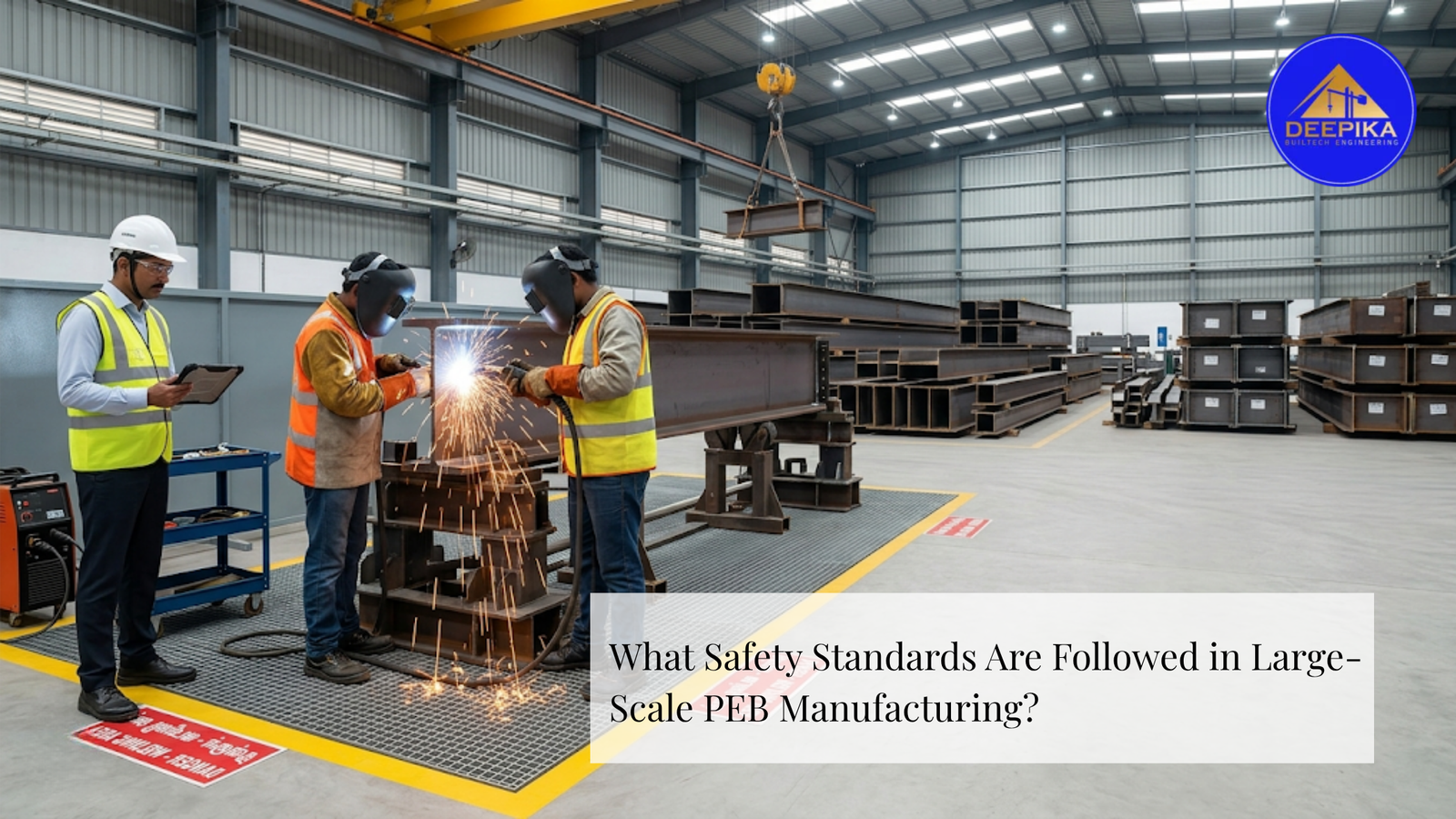
What Safety Standards Are Followed in Large-Scale PEB Manufacturing?
Table of Contents
Introduction: Why Safety Standards in PEB Manufacturing Matter More Than You Think
Most buyers ask about price, timeline, and span width when commissioning a PEB building. Very few ask about safety standards. That is a gap worth closing before you sign anything.
Safety standards in large-scale PEB manufacturing are not bureaucratic checkboxes. They are the engineering controls that determine whether your structure performs as designed under real load, survives Chennai’s monsoon wind pressures, resists the coastal humidity that accelerates corrosion, and remains safe for the workers operating inside it for decades.
If you have read about the PEB building manufacturing process step by step or how large-scale PEB manufacturing is transforming industrial construction in earlier guides on this site, you will understand the production stages involved. This guide focuses specifically on the safety and compliance layer that governs each of those stages. It covers which standards apply, what they require, and what happens to your building when they are not followed.
What Does PEB Manufacturing Safety Standards Actually Mean?
The phrase covers two distinct but related areas. The first is product safety: the standards that govern the quality, strength, and durability of the PEB components themselves. The second is process safety: the standards that protect the workers manufacturing those components in the factory and erecting the structure on your site.
Both matter to you as a buyer. Product safety standards determine whether your building holds up. Process safety standards determine whether the manufacturer is operating a professionally managed facility or cutting corners on personnel and equipment maintenance to reduce costs.
A PEB manufacturer who follows PEB structural safety compliance requirements across both areas is a fundamentally different kind of partner from one who treats standards as optional. The difference shows up in your structure’s performance, your insurance position, your regulatory standing with TNPCB, and your ability to obtain NABH, SIDCO, or industrial zone operating approvals.
Core Safety Standards Followed in Large-Scale PEB Manufacturing
Structural Steel Grade Standards: IS 2062 and IS 811
The foundation of safety standards for steel building fabrication is the steel grade itself. Primary structural frames in a PEB building are fabricated from IS 2062 grade steel, with E250, E300, or E350 specifications selected based on the design load requirements. Secondary members, including purlins, girts, and eave struts, are produced from IS 811 cold-formed section material.
These grades are not interchangeable. Using sub-grade steel or unverified material without a BIS mill test certificate means the actual yield strength of your structure’s members is unknown. A column designed for E350 steel performing at E250 strength carries a structural risk that is invisible until it is not.
Deepika Builtech verifies incoming steel against mill test certificates at both its Kanchipuram and Thirumullaivoyal manufacturing units before any material enters production. Every primary frame member is traceable to a specific heat of steel with a known mechanical property record.
Weld Quality Standards: IS 816 and Procedure Qualification
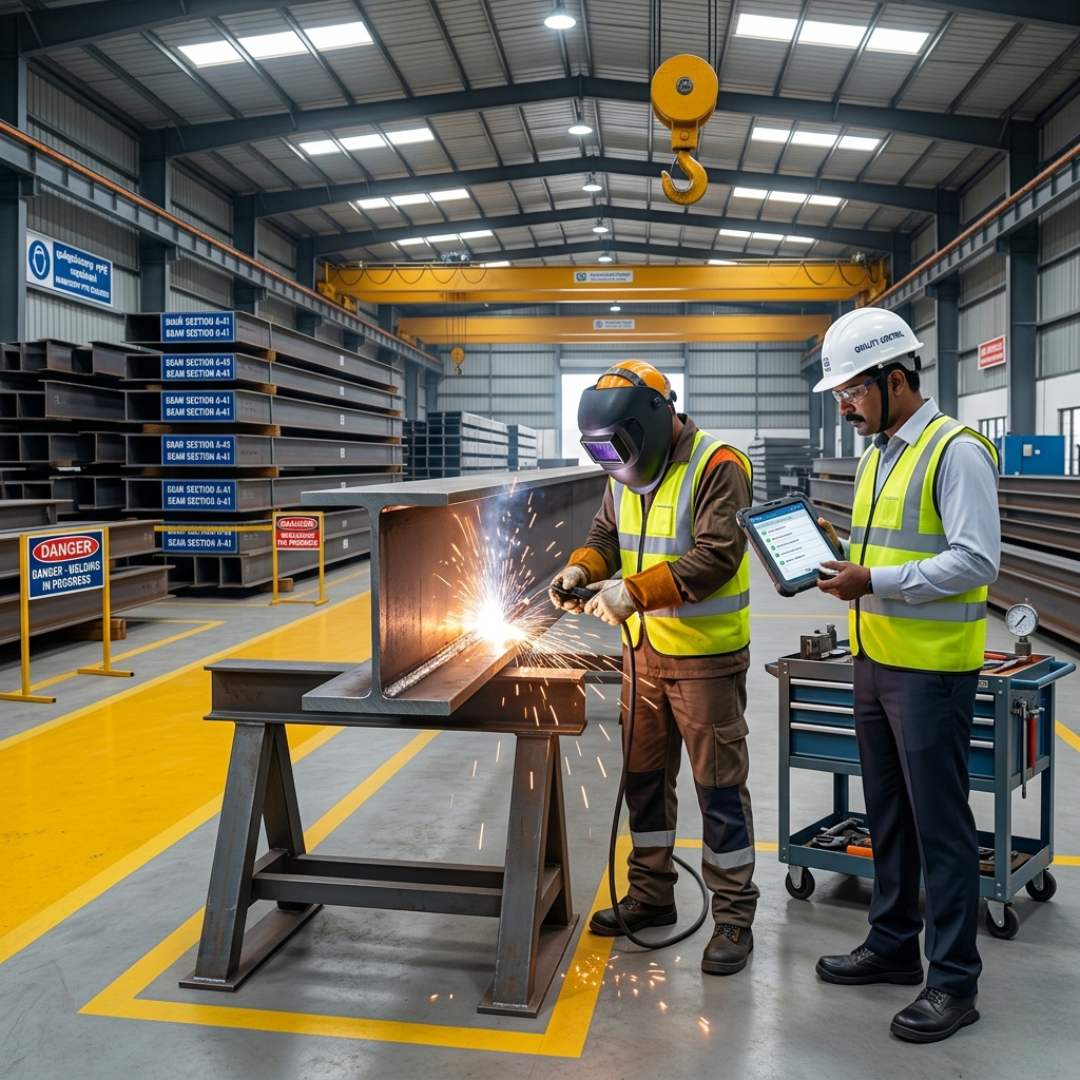
Welding is the most safety-critical activity in large-scale PEB manufacturing. Every weld in a primary frame is a structural element. IS 816 governs the use of metal arc welding for general construction in mild steel, specifying joint preparation, electrode selection, preheating requirements, and acceptance criteria.
Beyond the standard itself, procedure qualification matters just as much. A welder who has not been qualified to a written welding procedure specification is making engineering decisions on the shop floor without a defined process. The result is welds that vary in penetration depth, throat size, and fusion quality from joint to joint.
Deepika Builtech uses submerged arc welding for primary frame production, procedure-qualified MIG welding for connection plates and stiffeners, and CO2 welding for site joints. Each process is matched to the joint type and structural requirement, not selected for convenience.
Dimensional Tolerance Standards: IS 7215
IS 7215 specifies the permissible tolerances for fabricated steel structures. These tolerances govern column straightness, beam camber, end plate squareness, and bolt hole positional accuracy.
Here is why this matters practically. A column with an end plate that is 3mm out of square transfers an eccentric load into the foundation connection. Multiply that across 20 columns, and you have a structure that is working harder in its connections than the design assumed. Over time, under cyclic wind and live loads, this translates into fatigue at the connection points.
CNC cutting and drilling equipment produce components within IS 7215 tolerances consistently. Manual fabrication does not. This is one of the clearest, most measurable differences between a manufacturer who follows PEB manufacturing safety standards and one who does not.
Protective Coating Standards: Shot Blasting to Sa 2.5 and TNPCB Compliance
Shot blasting to Sa 2.5 surface preparation standard is the baseline requirement for protective coating in large-scale PEB manufacturing. Without Sa 2.5 preparation, any primer or topcoat applied over mill scale or surface contamination will fail adhesion within two to three years in Chennai’s humidity and coastal salt air environment.
Beyond structural performance, TNPCB consent conditions for industrial facilities in Chennai and Tamil Nadu include specifications for paint systems and surface treatment processes in manufacturing units. A manufacturer operating without current TNPCB consent is an environmental compliance risk for your procurement records.
Deepika Builtech applies primer and finish coats to a specified dry film thickness matched to each project’s exposure category. A warehouse in Thirumullaivoyal near the coast requires a different coating system from a dry inland factory. That specification is not generic. It is engineered for the specific site conditions.
Factory Safety Standards: Factories Act and Tamil Nadu Labour Regulations
The Tamil Nadu Labour Department administers the Factories Act 1948 as applicable to manufacturing units across the state. For a PEB fabrication facility, this covers machine guarding on press brakes and roll-forming lines, overhead crane safe working load certification, electrical installation safety, housekeeping standards, and emergency evacuation procedures.
A manufacturing unit that does not meet the Factories Act requirements is not just a worker safety risk. It is an operational risk for you as a client. A facility that suffers a notifiable accident faces a mandatory production stoppage during investigation. That directly affects your delivery schedule.
Ask any PEB manufacturer for their current Factory Licence and any recent safety inspection records. A professionally managed facility has these available without hesitation.
Site Erection Safety: IS 800 and Fall Prevention Protocols
IS 800 is the Indian standard for the general construction in steel, which governs the erection of structural steelwork, including PEB frames on site. It specifies sequence requirements, temporary bracing at each erection stage, safe working load limits for lifting equipment, and connection completion requirements before releasing crane loads.
Fall prevention is the single highest-risk activity in PEB erection. Working at height on partially completed frames without a defined safe access and fall arrest system is the leading cause of serious injuries in steel construction. A professional erection team operates with scaffold access to all connection points, personal fall arrest systems for work above 2 metres, and a documented lift plan for each crane operation.
Deepika Builtech’s construction services team manages erection with fully trained site operatives, documented lift plans, and health and safety protocols covering every phase from column erection through ridge installation.
Complete PEB Manufacturing Safety Standards Reference Table
| Safety Area | Applicable Standard | What It Governs | Consequence of Non-Compliance |
|---|---|---|---|
| Steel Grade | IS 2062, IS 811 | Primary frame and secondary member material specification and yield strength | Structural under-performance, connection failures, unknown load capacity |
| Welding | IS 816, WPS/PQR | Joint preparation, electrode selection, penetration depth, and welder qualification | Weld failures under fatigue, invisible fusion defects, and structural risk |
| Dimensions | IS 7215 | Fabrication tolerances for straightness, squareness, and bolt hole position | Eccentric loads at connections, erection problems, and long-term fatigue |
| Coating | Sa 2.5, DFT spec | Surface preparation standard, dry film thickness, coating system for exposure | Premature corrosion, structural degradation, TNPCB non-compliance |
| Emission Compliance | TNPCB Consent | Paint shop emissions, shot blast dust management, and effluent from surface treatment | Enforcement action, facility shutdown, client procurement risk |
| Factory Safety | Factories Act 1948 | Machine guarding, crane SWL, electrical safety, emergency procedures | Production stoppage, regulatory action, and delivery schedule impact |
| Site Erection | IS 800 | Erection sequence, temporary bracing, crane lift plans, and fall prevention | Structural collapse risk, serious injuries, and project liability |
| General Construction | IS 875 (Wind/Live Load) | Design load calculations for wind, live, dead and imposed loads | Structural underdesign for Chennai's wind zone requirements |
How Safety Standards Directly Affect Your Building’s Performance
Here is something worth being clear about: PEB structural safety compliance standards are not separate from building performance. They are the same thing expressed in a different language.
A structure fabricated from verified IS 2062 E350 steel, welded to IS 816 procedure, held to IS 7215 dimensional tolerance, coated to Sa 2.5 preparation and specified dry film thickness, and erected to IS 800 sequence requirements will perform as its structural engineer designed it. For its full design life. Under the load conditions it was specified for.
A structure where any one of those standards was not followed will perform differently from the design. Possibly not significantly, possibly catastrophically, but always unpredictably. You will not know which until it matters.
For your warehouse in Chennai or your EOT crane-equipped manufacturing facility, that unpredictability is not an acceptable outcome. The entire financial case for a PEB structure over conventional construction rests on its long-term reliability. Safety standards are what deliver that reliability.
What to Ask a PEB Manufacturer About Their Safety Compliance
These questions will tell you more about a manufacturer’s actual safety standards than any brochure or website claim:
- Which steel grades do you use for primary frames, and can you provide mill test certificates for recent orders?
- Are your welders qualified to write welding procedure specifications, and which welding processes are used for primary frame fabrication?
- What is your shot blasting standard, and how do you specify coating DFT for different exposure conditions?
- Do you hold a current Factory Licence, and when was your last inspection under the Factories Act?
- Can I see your IS 7215 dimensional check records from a recent production run?
- What is your erection safety protocol, and do your site teams work under a documented lift plan?
- Do you hold current TNPCB consent for your manufacturing units?
A manufacturer who answers all seven with specifics and documentation has a compliance-managed operation. One who deflects, generalises, or discourages questions about their facility is telling you something important.
How Deepika Builtech Applies PEB Manufacturing Safety Standards
Put Deepika Builtech against the standards in this guide, and the answers are consistent at every level.
Incoming steel is verified against BIS mill test certificates before production at both the Kanchipuram and Thirumullaivoyal units. Primary frames are welded using submerged arc welding with procedure-qualified welders. CNC cutting and drilling equipment ensures IS 7215 dimensional compliance throughout every production run.
Shot blasting to Sa 2.5 and coating to project-specific dry film thickness is standard across all orders. Both manufacturing units operate under current TNPCB consent conditions and comply with Tamil Nadu Factories Act requirements. Site erection teams work under documented lift plans, fall prevention protocols, and IS 800 erection sequence requirements.
Their track record of 150+ completed projects and 100+ satisfied clients across Chennai and Tamil Nadu is evidence that these safety standards are applied consistently, not occasionally. You can review their completed project portfolio and contact the team to discuss compliance documentation for your specific project.
Conclusion: Safety Standards Are Not Paperwork. They Are Performance.
Every PEB manufacturing safety standard covered in this guide exists because a structure built without it will perform below its design intent in a way that is measurable, predictable, and preventable.
The businesses that commission PEB buildings in Chennai that hold up for 20 to 30 years under real operational loads are the ones that asked the right questions upfront. They verified steel grades. They checked welder qualifications. They confirmed coating specifications. They visited the factory.
Deepika Builtech’s approach to PEB structural safety compliance is built into every stage of their manufacturing operation, from material intake to site handover. If you are planning a large-scale PEB project in Chennai and want a manufacturer who can demonstrate their compliance position rather than just assert it, get in touch here for a free consultation.
FAQs:
1. Which BIS standards apply to large-scale PEB manufacturing in India?
The primary BIS standards that govern large-scale PEB manufacturing include IS 2062 for structural steel grade and mechanical properties, IS 811 for cold-formed steel sections used in secondary members, IS 816 for metal arc welding of structural steel, IS 7215 for fabrication dimensional tolerances, and IS 800 for the general code of practice for construction in steel, covering both design and erection. These standards work together across the full manufacturing and erection chain. A manufacturer who is not demonstrably compliant with all of them is producing a structure with unknown safety characteristics in at least one critical area.
2. How does weld quality affect the structural safety of a PEB building?
Every weld in a PEB primary frame is a structural element carrying real design loads. A weld with insufficient penetration depth, incorrect throat size, or porosity from inadequate procedure control is weaker than the design assumes. Under static load, it may perform acceptably. Under the cyclic loads imposed by wind, thermal cycling, and crane operations, under-specified welds accumulate fatigue damage that eventually produces cracking at connection points. IS 816 weld quality standards and formal welder procedure qualification exist specifically to prevent this. A manufacturer who cannot demonstrate procedure qualification records is accepting an unknown structural risk that transfers to your building.
3. Why does TNPCB compliance matter for a PEB manufacturer in Chennai?
TNPCB consent conditions for industrial manufacturing facilities in Tamil Nadu cover paint shop emissions, shot blast dust management, surface treatment effluent, and noise levels. A PEB manufacturer operating without current consent conditions violates the Environment Protection Act. For you as a buyer, this creates a procurement compliance risk: your supply chain includes an environmentally non-compliant vendor. It also creates an operational risk: a facility receiving enforcement action faces production suspension that directly affects your delivery schedule. Verifying current TNPCB consent before committing to a manufacturer is straightforward and takes one request.
4. How does Deepika Builtech ensure PEB manufacturing safety standards across its facilities?
Deepika Builtech maintains compliance with PEB manufacturing safety standards at every production stage across both its Tamil Nadu manufacturing units. Steel procurement is verified against BIS mill test certificates. Primary frame welding uses SAW with procedure-qualified welders under IS 816. CNC fabrication maintains IS 7215 dimensional tolerances. Shot blasting to Sa 2.5 and project-specific coating application is standard. Both units hold current TNPCB consent and comply with Tamil Nadu Factories Act requirements. Site erection operates under IS 800 sequence requirements with documented fall prevention and lift planning. Their PEB construction service reflects a manufacturing operation where safety compliance is built in, not inspected after the fact.
5. How do I get started with a PEB project with Deepika Builtech in Chennai?
Call +91 96000 67611 or email dbtechengg@gmail.com for a free initial project consultation. You can also submit your enquiry via the contact page. A factory visit to either Kanchipuram or Thirumullaivoyal can be arranged before any commitment, so you can see the manufacturing and safety standards in practice rather than on paper. View their completed projects to understand the scale and type of builds they have delivered across Chennai and Tamil Nadu.
