
deepikabuiltech.com

Deepika Blogs

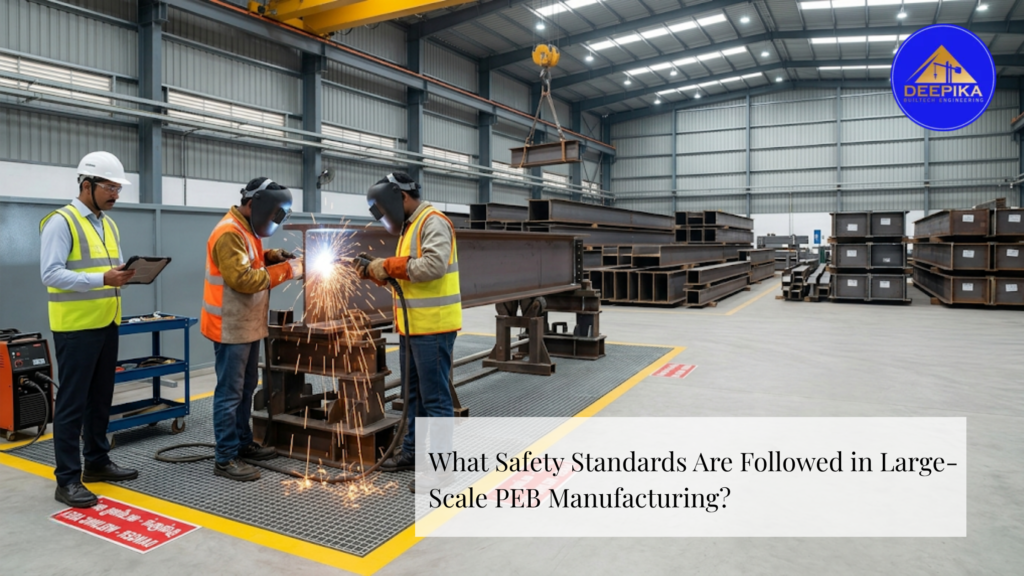
Large Scale PEB Manufacturing showing welding safety practices steel fabrication and quality inspection in Chennai
Deepika Blogs

What Safety Standards Are Followed in Large-Scale PEB Manufacturing?

What Safety Standards Are Followed in Large-Scale PEB Manufacturing? Table of Contents Introduction: Why Safety Standards in PEB Manufacturing Matter More Than You Think Most buyers ask about price, timeline, and span width when commissioning a PEB building. Very few ask about safety standards. That is a gap worth closing before you sign anything. Safety standards in large-scale PEB manufacturing are not bureaucratic checkboxes. They are the engineering controls that determine whether your structure performs as designed under real load, survives Chennai’s monsoon wind pressures, resists the coastal humidity that accelerates corrosion, and remains safe for the workers operating inside it for decades. If you have read about the PEB building manufacturing process step by step or how large-scale PEB manufacturing is transforming industrial construction in earlier guides on this site, you will understand the production stages involved. This guide focuses specifically on the safety and compliance layer that governs each of those stages. It covers which standards apply, what they require, and what happens to your building when they are not followed.   What Does PEB Manufacturing Safety Standards Actually Mean? The phrase covers two distinct but related areas. The first is product safety: the standards that govern the quality, strength, and durability of the PEB components themselves. The second is process safety: the standards that protect the workers manufacturing those components in the factory and erecting the structure on your site. Both matter to you as a buyer. Product safety standards determine whether your building holds up. Process safety standards determine whether the manufacturer is operating a professionally managed facility or cutting corners on personnel and equipment maintenance to reduce costs. A PEB manufacturer who follows PEB structural safety compliance requirements across both areas is a fundamentally different kind of partner from one who treats standards as optional. The difference shows up in your structure’s performance, your insurance position, your regulatory standing with TNPCB, and your ability to obtain NABH, SIDCO, or industrial zone operating approvals. Core Safety Standards Followed in Large-Scale PEB Manufacturing Structural Steel Grade Standards: IS 2062 and IS 811 The foundation of safety standards for steel building fabrication is the steel grade itself. Primary structural frames in a PEB building are fabricated from IS 2062 grade steel, with E250, E300, or E350 specifications selected based on the design load requirements. Secondary members, including purlins, girts, and eave struts, are produced from IS 811 cold-formed section material. These grades are not interchangeable. Using sub-grade steel or unverified material without a BIS mill test certificate means the actual yield strength of your structure’s members is unknown. A column designed for E350 steel performing at E250 strength carries a structural risk that is invisible until it is not. Deepika Builtech verifies incoming steel against mill test certificates at both its Kanchipuram and Thirumullaivoyal manufacturing units before any material enters production. Every primary frame member is traceable to a specific heat of steel with a known mechanical property record. Weld Quality Standards: IS 816 and Procedure Qualification Welding is the most safety-critical activity in large-scale PEB manufacturing. Every weld in a primary frame is a structural element. IS 816 governs the use of metal arc welding for general construction in mild steel, specifying joint preparation, electrode selection, preheating requirements, and acceptance criteria. Beyond the standard itself, procedure qualification matters just as much. A welder who has not been qualified to a written welding procedure specification is making engineering decisions on the shop floor without a defined process. The result is welds that vary in penetration depth, throat size, and fusion quality from joint to joint. Deepika Builtech uses submerged arc welding for primary frame production, procedure-qualified MIG welding for connection plates and stiffeners, and CO2 welding for site joints. Each process is matched to the joint type and structural requirement, not selected for convenience.   Dimensional Tolerance Standards: IS 7215 IS 7215 specifies the permissible tolerances for fabricated steel structures. These tolerances govern column straightness, beam camber, end plate squareness, and bolt hole positional accuracy. Here is why this matters practically. A column with an end plate that is 3mm out of square transfers an eccentric load into the foundation connection. Multiply that across 20 columns, and you have a structure that is working harder in its connections than the design assumed. Over time, under cyclic wind and live loads, this translates into fatigue at the connection points. CNC cutting and drilling equipment produce components within IS 7215 tolerances consistently. Manual fabrication does not. This is one of the clearest, most measurable differences between a manufacturer who follows PEB manufacturing safety standards and one who does not.   Protective Coating Standards: Shot Blasting to Sa 2.5 and TNPCB Compliance Shot blasting to Sa 2.5 surface preparation standard is the baseline requirement for protective coating in large-scale PEB manufacturing. Without Sa 2.5 preparation, any primer or topcoat applied over mill scale or surface contamination will fail adhesion within two to three years in Chennai’s humidity and coastal salt air environment. Beyond structural performance, TNPCB consent conditions for industrial facilities in Chennai and Tamil Nadu include specifications for paint systems and surface treatment processes in manufacturing units. A manufacturer operating without current TNPCB consent is an environmental compliance risk for your procurement records. Deepika Builtech applies primer and finish coats to a specified dry film thickness matched to each project’s exposure category. A warehouse in Thirumullaivoyal near the coast requires a different coating system from a dry inland factory. That specification is not generic. It is engineered for the specific site conditions.   Factory Safety Standards: Factories Act and Tamil Nadu Labour Regulations The Tamil Nadu Labour Department administers the Factories Act 1948 as applicable to manufacturing units across the state. For a PEB fabrication facility, this covers machine guarding on press brakes and roll-forming lines, overhead crane safe working load certification, electrical installation safety, housekeeping standards, and emergency evacuation procedures. A manufacturing unit that does not meet the Factories Act requirements is not just a worker safety risk. It
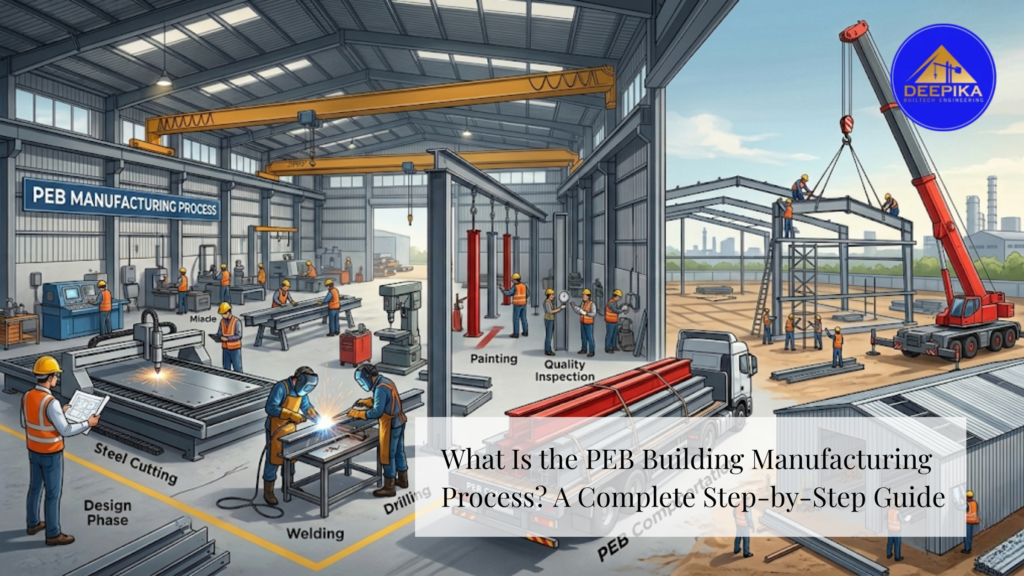

PEB building manufacturing process showing steel fabrication welding painting and erection of industrial structure in Chennai
Deepika Blogs

What Is the PEB Building Manufacturing Process? A Complete Step-by-Step Guide

What Is the PEB Building Manufacturing Process? A Complete Step-by-Step Guide Table of Contents Introduction: What Most Buyers Never Find Out Until It Is Too Late Most businesses that commission a PEB building in Chennai make the same mistake. They compare quotes, pick a price, and sign. They never ask a single question about how the building is actually made. That matters more than most people realise. The PEB building manufacturing process is where quality is either built in or left out. By the time your structure is on site and going up, every engineering decision, the steel grade, the weld quality, the coating system, and the dimensional accuracy are already locked into every component on that truck. If you have read about the latest construction trends in Chennai in 2026 or the steel buildings manufacturing trends covered on this site, you will have some context. This guide goes deeper. It walks you through every stage of the PEB building manufacturing process so you know exactly what a quality manufacturer does, where shortcuts are commonly taken, and what questions to ask before you commit. What Is the PEB Building Manufacturing Process? A Pre-Engineered Building is not built on your site from raw materials. It is engineered and fabricated in a factory, then transported to your site as a kit of precision-made structural components that bolt and weld together into a complete steel frame. The PEB building manufacturing process covers everything from your initial load and span requirements through structural design, steel procurement, CNC fabrication, welding, protective coating, and quality-checked dispatch to your site. Site work foundations, erection, roofing, and cladding, then complete the build. What separates a well-manufactured PEB building from a poorly made one is invisible once the structure is up. You cannot see the steel grade, the weld penetration depth, or the coating thickness from the outside. But you will see the consequences of poor manufacturing within a few years. That is why understanding the pre-engineered building construction steps before you choose a manufacturer is not optional. It is the most important due diligence step in your project. Step-by-Step: The Complete PEB Building Manufacturing Process Step 1: Client Brief and Load Requirement Analysis The process starts with your requirements, not a standard template. Span width, bay spacing, roof pitch, wind load zone, floor load, crane capacity, if any, and intended use all feed into the initial design brief. A serious manufacturer conducts a structured load requirement analysis before a single drawing is produced. Deepika Builtech does this through an on-site assessment at their Ambattur office, covering your exact site conditions, structural requirements, and operational needs before any engineering begins. If a manufacturer skips this step and jumps straight to a standard design, that is a signal worth noting. Step 2: Structural Design and Engineering Drawings Once load requirements are confirmed, the structural engineering team produces primary frame designs, connection details, foundation load calculations, and fabrication drawings. These drawings define every member column, rafters, purlins, bracing, and crane beams with precise dimensions and material specifications aligned with BIS structural steel standards. This is where the pre-engineered building construction steps are determined for the entire project. Any error at this stage propagates through every downstream step. The drawings must be reviewed and approved before fabrication begins. Ask to see the structural drawings before you sign a contract. A manufacturer who cannot provide them has not done this step properly. Step 3: Steel Procurement and Grade Verification The structural drawings specify the steel grades required for each member. Primary frames typically use IS 2062 E250 or higher grade steel. Purlins and secondary members use cold-formed sections from the IS 811 specification material. At Deepika Builtech’s manufacturing units in Kanchipuram and Thirumullaivoyal, incoming steel is verified against mill test certificates before it enters production. This step is frequently skipped by lower-cost manufacturers. The consequence is variable steel quality in the same structure, which creates unpredictable performance under load. Step 4: CNC Cutting, Drilling and Plate Fabrication This is where the PEB steel structure fabrication process becomes measurably different between manufacturers. CNC plate cutting equipment produces components with a dimensional accuracy of plus or minus 0.5mm. Manual cutting produces tolerances of 3-5mm or worse. Those tolerances matter on site. Misaligned bolt holes, columns that do not sit square on base plates, and rafters that do not meet correctly at the ridge are almost always traced back to inaccurate cutting at the fabrication stage. Deepika Builtech uses CNC profiling and drilling machinery at both manufacturing units. Every cut plate and drilled hole is produced to drawing specification, not to a site operative’s judgment. Step 5: Welding and Primary Frame Assembly Primary structural members, columns and rafters are built-up sections welded from plates. The web and flange plates are fillet-welded using submerged arc welding (SAW) for consistent, full-penetration welds along the full member length. Connection plates, stiffeners, and end plates are added using MAG and MIG welding processes. Every weld is a structural element. A weld that looks correct on the surface but lacks proper fusion depth will fail under cyclic load long before the design life is reached. Ask your manufacturer which welding processes they use and whether welders are procedure-qualified. Deepika Builtech uses SAW for primary members, MIG for secondary connections, and CO2 for site joints, each matched to the joint type and load requirement. Step 6: Shot Blasting and Protective Coating Before any coating is applied, fabricated members go through shot blasting to the Sa 2.5 standard. This removes mill scale, rust, and surface contamination down to a clean steel surface. Without this step, any coating applied over contaminated steel will fail within two to three years, regardless of its specified thickness. Chennai’s coastal humidity, monsoon moisture, and industrial atmosphere create aggressive corrosion conditions. TNPCB compliance for industrial facilities also specifies coating requirements for structural steel in certain zone classifications. Deepika Builtech applies a primer coat followed by a finish coat to a total dry film thickness appropriate for the project’s

Construction engineers planning a building project at site in Chennai with crane and workers in background
Deepika Blogs

How to Identify a Reliable Construction Company Before Starting Your Project

How to Identify a Reliable Construction Company Before Starting Your Project Table of Contents Introduction: Why This Decision Matters More Than Your Budget Here is something most businesses in Chennai learn too late: your construction outcome is not decided by your budget. It is decided by the company you trust to manage it. Pick the wrong builder, and the most generous budget in the world will not save you from structural rework, regulatory issues, missed deadlines, or a building that starts showing problems within two years of handover. Pick a reliable construction company, and even with a tight budget, materials are specified correctly, and your facility is delivered to a standard that holds up under real operational loads. If you want to understand what the modern construction industry in Chennai looks like in 2026 before going further, that context is worth reading first. This guide focuses on what to look for and what to ask before you sign anything. The signs are consistent. The questions are specific. And the checklist at the end of this article will help you evaluate any construction company in Chennai with clarity and confidence.   What a Reliable Construction Company in Chennai Actually Looks Like A reliable construction company is not the one with the most impressive brochure or the lowest initial quote. It is the one that shows its track record, explains its process, and stands behind its work with documentation and references you can actually verify. In Chennai’s industrial construction market, where projects range from 500 sqm workshops to multi-building manufacturing campuses, reliability shows up in five specific, observable ways.   A Verifiable Project Portfolio in Your Sector The first thing to check is not how long the company has been in business. It is whether they have built what you need, at the scale you need, and for clients whose operations look like yours. A company with 150 completed residential projects is a different proposition from one with 150 completed industrial facilities. Deepika Builtech has delivered 150+ projects across PEB buildings, warehouse construction, cold storage, mezzanine floors, steel structures, and EOT crane installations in Chennai and across Tamil Nadu. That is sector-specific depth that changes project outcomes. Review their completed projects portfolio and ask to see at least five comparable builds. If they cannot provide that, note it.   In-House Engineering and Fabrication Capability A reliable construction company does not outsource its core engineering work. If a firm sends your structural drawings to a third-party engineer and your steel fabrication to an unrelated factory, there is no single point of accountability when things do not match. In-house capability means the same team that designs your structure also fabricates the components and installs them on-site. Deepika Builtech operates this model across its Ambattur office and manufacturing units in Kanchipuram and Thirumullaivoyal. CNC precision manufacturing, MIG and submerged arc welding, and protective coating application all happen in-house. That is not a marketing claim. It is an engineering quality control mechanism.   Transparent Project Management From Day One You should never wonder what is happening on your construction site. A professional construction company provides a documented project schedule at the outset, regular progress updates throughout, and a clear escalation path when issues arise. If the company you are evaluating cannot tell you upfront how they communicate milestones and who your single point of contact will be, that is a reliability signal worth taking seriously. You can see how Deepika Builtech structures their construction services delivery on their services page.   Compliance With Tamil Nadu Safety and Regulatory Standards Chennai’s industrial construction environment has specific regulatory requirements: TNPCB consent conditions for industrial zones, SIDCO building regulations, local panchayat or municipal authority approvals, and structural certification requirements aligned with BIS standards. A trusted construction company in Chennai knows these requirements without being prompted. They have completed projects through compliance inspections before. Ask them directly: which specific regulatory requirements apply to your proposed site, and how do they handle compliance documentation? Their answer tells you a great deal.   Client References That Actually Pick Up the Phone References are the single most reliable signal of a trustworthy construction company. Not testimonials on a website. Not a list of logos in a brochure. Ask for direct contact details of two or three past clients who completed projects of comparable size in the last three years. Then call them. Ask whether the project was delivered on time, whether the structure performs as expected, and whether they would engage the company again. The answers you get in those conversations are worth more than any sales presentation.   Questions to Ask Before Signing Any Construction Contract Before you commit to any construction company in Chennai, ask these questions directly. A reliable firm answers all of them with specifics, not generalities. How many projects of this type and scale have you completed in the last three years? Can I visit a recently completed project and speak with that client? Is structural design, fabrication, and installation all handled in-house under one contract? How do you handle scope changes and variation orders during construction? What specific compliance requirements apply to my site, and how do you manage that documentation? Who is my single point of contact from design through to handover? What does your project schedule look like, and how do you report progress? What warranty documentation, as-built drawings, and handover package do you provide? If a company hesitates on any of these or gives vague answers about their process, that is important information. A reliable construction company answers every one of these questions confidently and with examples.   Complete Pre-Project Evaluation Checklist Use this checklist when evaluating any construction company in Chennai before signing a contract.    What to Check What a Reliable Firm Does Red Flag to Watch For Project Portfolio 5+ completed projects in your specific sector Only the general or residential portfolio is shown In-House Engineering Structural design done by their own engineers Design outsourced to third-party consultants Fabrication Capability

How Long Does It Take to Construct a PEB Building?
Deepika Blogs

How Long Does It Take to Construct a PEB Building?

How Long Does It Take to Construct a PEB Building? Home Table of Contents The construction industry is changing fast due to the increasing need for faster, stronger, and cost-effective solutions for businesses. The traditional construction methods used by companies often involve a longer period of construction, high labor costs, and high rates of material wastage. To address these issues, different industries are opting for Pre-Engineered Buildings (PEB). Pre-Engineered Buildings are modern structures made of steel that are built in a factory and assembled on-site during construction. This method helps companies reduce the construction period while ensuring a strong and efficient building. Deepika Builtech Engineering is a company that provides efficient PEB solutions for different industries. In this article, we will discuss the importance of PEB structures for businesses in India. What Are Pre-Engineered Buildings? Pre-engineered buildings are steel structures that comprise various parts like columns, beams, and roof panels that are designed and manufactured in a factory. The parts are then transported to the building site for assembly. Unlike the traditional method of construction, in which materials are processed on the site itself, the Pre-engineered method is based on the principle of pre-fabricated parts that can be fitted together with great accuracy. This results in quick as well as quality constructions. Pre-engineered buildings are generally used for: Industrial Factory Buildings Warehouses Commercial Buildings Cold Storage Buildings Agricultural Buildings Aircraft Hangers Companies like Deepika Builtech Engineering provide Pre-engineered solutions. Key Features of Pre-Engineered Buildings Pre-Engineered Buildings have a number of features that make them superior to the conventional method of construction.  1.Faster Construction Time One of the major advantages of Pre-Engineered Buildings is that they can be built quickly. This is because the materials are manufactured in a factory, and the construction work can be done simultaneously on the site.  This saves a lot of time for the organization to start its operations.  2.High Structural Strength Pre-Engineered Buildings are made of high-grade steel materials that are extremely strong. The steel materials used for the construction of these buildings are columns, rafters, purlins, and girders.  These buildings are extremely strong and can withstand harsh weather conditions as well as the weight of heavy machinery. 3.Cost Efficiency Conventional construction methods often result in material wastage, increased labor delays, and maintenance costs. PEB construction minimizes material usage and optimizes the same for reduced waste. The benefits include: Low labor cost Less construction time required Minimal material wastage during construction Low maintenance cost over a period of time Thus, PEB construction proves to be a cost-effective option for businesses. 4.Customizable Designs Businesses have different requirements for infrastructure. PEB construction provides fully customized solutions for different needs like: Large spaces for warehouses High ceilings for manufacturing plants Mezzanine floors for additional storage capacity Crane facilities for industries The structures are designed by engineers based on the needs of the business. 5.Eco-Friendly Construction Another factor that is taken into consideration while constructing buildings now is sustainability. The steel used to construct the PEB buildings can be recycled. This reduces the waste produced during the construction phase. Some of the eco-friendly features that can be used to construct the PEB buildings are: Solar Panels Rain Water Harvesting Insulation Ventilation These eco-friendly features not only help us save energy, but they can also help us save our environment. Applications of PEB Buildings PEB construction is widely used in various industries due to its flexibility and reliability.  Industrial Manufacturing Units Factories need large open areas, a strong structural system, and a good ventilation system. PEB buildings are suitable for industrial units. Factories have to accommodate large industrial equipment.  Warehousing and Logistics The rise of e-commerce and the growth of the supply chain have increased the demand for warehouses. PEB buildings are suitable for warehouses. Warehouses need large open areas, high ceilings, and expansion facilities.  Cold Storage Facilities Cold storage facilities need a controlled environment. PEB buildings can provide a controlled environment.  Commercial Buildings Retail stores, shopping malls, office complexes can be constructed using PEB technology. These types of buildings provide a modern look along with the benefits of a strong structural system. The PEB Construction Process The Pre-Engineered Building construction process is a structured one. The process is as follows: 1.Project Planning The first step in the process is to plan the project. The requirements need to be understood at this stage. 2.Design and Engineering The design and engineering process involves drawing the design for the Pre-Engineered Building. The design is created by expert engineers who use sophisticated technology for the design. The design is created in such a way that the Pre-Engineered Building can withstand all conditions. 3.Fabrication The third step in the Pre-Engineered Building process is fabrication. The fabrication process involves cutting the steel and preparing the Pre-Engineered Building components in a factory. The process involves the following steps: Steel Cutting Welding Drilling Coating 4.Site Preparation During the Pre-Engineered Building process, the site is prepared for the Pre-Engineered Building. The foundation for the Pre-Engineered Building was prepared during this time. The anchor bolts for the Pre-Engineered Building are fixed during this period. 5.Transportation and Installation The Pre-Engineered Building components are transported and installed at the site. The Pre-Engineered Building components are installed by expert engineers. The Pre-Engine Why Choose Professional PEB Construction Companies? Choosing the right construction partner is a key factor for the success of any construction project. Professional construction companies help in: Accurate structural design Quality steel material usage Professional construction methods Effective management practices Reliable installation methods Professional construction companies like Deepika Builtech Engineering provide end-to-end solutions for planning, fabrication, and installation services for building efficient and durable steel structures. With their vast industry expertise, modern construction facilities, and customer-centric services, construction companies help businesses build structures that help them grow. The Future of PEB Construction The global construction industry is increasingly embracing the use of PEB technology due to its efficiency and sustainability. The future trends of PEB construction technology are: Smart Building Integration Energy-Efficient Materials Advanced Prefabrication Technologies Digital Construction Planning

Construction Industry trends showing modern building technology cranes modular construction and smart site management
Deepika Blogs

What Are the Latest Trends in the Construction Industry in 2026?

What Are the Latest Trends in the Construction Industry in 2026? Table of Contents The construction industry is constantly changing and growing, especially in cities like Chennai that are witnessing continuous growth in the development of industries and infrastructure. Businesses today demand robust and efficient structures that will last long and be cost-effective. This is where the role of an efficient and experienced construction company comes into play. A reliable construction company will deliver projects that meet the highest engineering standards and efficient use of planning and technology. One such company that is contributing to the development of infrastructure in the region is Deepika Builtech. They offer pre-engineered buildings, steel structures, warehouses, and civil construction services.    In the following sections of the blog, we will learn the importance of choosing the right construction company and how modern construction solutions benefit businesses.   Understanding the Modern Construction Industry   The modern construction industry emphasizes speed, efficiency, durability, and sustainability. Traditional construction practices are being replaced by modern and advanced engineering practices such as steel structures, modular construction, and pre-engineered buildings.   The modern construction industry provides complete solutions to the needs of the construction sector. The solutions provided by modern construction companies include:   Planning and architectural design Structural engineering Fabrication and installation Project management Industrial and commercial construction Importance of Professional Construction Services Professional construction companies help ensure the proper and planned execution of the projects. The benefits of hiring professional construction companies are: High-Quality Construction Professional construction companies make use of high-quality materials and techniques in engineering for the construction of long-lasting structures. Efficient Project Management From the initial stages to the end, construction professionals ensure the efficient management of the projects in all aspects to avoid delays and costs. Safety and Compliance Professional construction companies ensure the maintenance of proper safety standards and government regulations. Cost-Effective Services Professional construction companies help in managing costs and constructing buildings at a low cost. Pre-Engineered Buildings: The Future of Construction One of the most popular construction technologies in today’s construction industry is Pre-Engineered Buildings. Pre-Engineered Buildings are those structures that are produced in a factory and installed at the construction site. Companies like Deepika Builtech are involved in designing and delivering Pre-Engineered Buildings. Benefits of Pre-Engineered Buildings Fast construction time Less labor cost High structural strength Design flexibility Less wastage of materials Pre-engineered buildings are being utilized in warehouses, factories, logistics, and commercial buildings. Industrial Construction Solutions Industrial construction is an important aspect that provides support to industrial operations. Industrial construction has evolved significantly and now includes large span constructions, robust materials, and efficient construction. Industrial construction services include: Factory buildings Manufacturing units Industrial sheds Steel structure buildings Logistics Industrial construction incorporates steel structures and efficient construction technologies, making these constructions suitable for heavy loads and harsh conditions. Warehouse Construction for Growing Businesses With the growth of industries, there is always an increase in the demand for efficient and effective warehouse construction. Warehouses play an important role in managing inventory and distribution. Customized solutions in warehouse construction emphasize: Optimizing storage space Efficient material handling Durability Flexibility in design Customized warehouse construction helps businesses increase productivity. Steel Structures and Metal Buildings Steel buildings have become the first choice in industrial and commercial construction. Steel structures are strong, flexible, and durable. The benefits of steel construction are: High load-bearing capacity Resistance to extreme weather conditions Fast construction process Less maintenance required Metal buildings are now being used for factory construction, warehouses, workshops, commercial buildings, and agricultural storage. Cold Storage Infrastructure for Modern Industries Cold storage is a necessary part of industries like food processing, pharmaceuticals, and agriculture. Cold storage construction involves: Insulated wall panels Energy-efficient refrigeration systems Temperature monitoring systems Structural durability for heavy equipment Advanced cold storage manufacturing systems ensure the safety of products and minimize any form of wastage. End-to-End Construction Solutions Businesses like to partner with construction services in chennai companies that offer end-to-end services, i.e., turnkey services. This means that the company will take care of all aspects of the project, from start to finish. Construction services that are part of turnkey services are: Evaluation of the site and feasibility study Architectural and structural designs Fabrication and procurement of materials Construction and installation Final inspection and project delivery Importance of Experienced Engineering Teams The success of any construction project depends on the experience and knowledge possessed by engineers, architects, and management teams. This is to ensure that the buildings are up to required specifications. Construction companies with experienced teams are able to handle complex projects such as: Large industrial warehouses Multi-level steel structures Commercial complexes Institutional buildings The presence of a strong engineering team is a guarantee that the structures are able to withstand the test of time. Importance of Experienced Engineering Teams The success of a construction project depends on the experience and knowledge available to engineers, architects, and management teams. This is to ensure that the structures are up to required standards. Construction companies with experienced teams are able to handle complex projects such as: Large industrial warehouses Multi-level steel structures Commercial complexes Institutional buildings The presence of a strong engineering team is a guarantee that the structures are able to withstand the test of time. Conclusion The construction industry is always in a state of development with the advent of new engineering techniques, modern construction materials, and effective construction management techniques. Nowadays, businesses need effective and efficient construction services with a high degree of cost-effectiveness. Deepika Builtech is a company that contributes to the development of the country by providing quality services in the form of pre-engineered buildings, steel structures, warehouse construction, and industrial construction. As the growth of industries and urban development is rising day by day, the role of effective construction services will remain significant in building the future. FAQs 1. What services does a construction company provide? A construction company provides services such as building design, structural engineering, project management, fabrication, and construction for residential, commercial, and industrial projects. 2. What

quality building materials used in construction including steel beams, concrete blocks, roof tiles, plumbing, insulation, and structural components
Deepika Blogs

Why Is Quality Building Material Important for Construction?

Why Is Quality Building Material Important for Construction? Table of Contents Quality building materials for construction are the single most important factor determining whether your factory or industrial facility stands strong for decades  or becomes a costly liability within years. If you’re an industrial owner in Chennai planning a new factory, warehouse, or Pre-Engineered Building (PEB), this FAQ guide will explain exactly why quality building materials for construction should be your top priority before breaking ground. FAQ 1: Why Quality Building Materials for Construction Matter in Industrial Projects   An industrial building is subjected to much more stress compared to a residential or commercial building. The stress an industrial building is subjected to includes the following: Heavy machinery loads: where the floor will have to withstand the constant vibration of machines Large roof spans: where the roof will have to be made of steel to avoid sags over a period of time Severe weather conditions in Chennai: where the humidity level is very high, the salty atmosphere will corrode the steel used for construction, and the rains will further damage the structure Fire resistance: The material used for the construction of the building should have a particular resistance level While a residential building will last for several decades even if constructed using average quality materials, an industrial building constructed using substandard materials will develop cracks in the structure within 3 to 5 years. This is where the owner of the factory will lose out. The bottom line: While the cost of using average materials will be less for a building, the return on investment for using quality materials will be much higher compared to the amount saved by using substandard materials. FAQ 2: Key Quality Building Materials for Construction of PEB Structures The major materials used in Pre-Engineered Buildings, which are the gold standard for industrial and warehouse construction today, are: Structural Steel (Primary Framing): Columns, Rafters, and Girders form the skeleton of your building. High-grade steel (IS 2062 Grade A or E250) with adequate yield strength is a prerequisite to ensure your building withstands wind pressure, seismic activity, and equipment loads without any deflection. Purlins and Girts (Secondary Framing): These are the supporting structures for your roof and wall claddings. Lightweight, high-strength steel Purlins make for efficient roof construction, which is a prerequisite for large-span roofs of factories and warehouses. Roofing and Wall Panels (Cladding): Galvalume and Galvanised Steel Sheets with a minimum 0.5mm thickness and AZ150 coating are the norm for industrial buildings. Cheap, low-grade panels have a life of only 2-3 monsoon seasons in the coastal climate of Chennai. Fasteners and Connections: Not many people focus on this, but low-grade bolts and anchor rods are the most common reasons for joint failures. Always insist on high-tensile bolts (Grade 8.8 minimum) with torque verification. Protective Coatings: Two-coat paint with primer and finish, using epoxy- and polyurethane-based coatings, adds an extra 20-30 years to the life of your steel structures. FAQ 3: How does material quality affect the lifespan of my factory building? This is one of the most important questions an industrial owner can ask. Here’s a realistic comparison: Factor Quality Materials Substandard Materials Structural lifespan 30–50 years 10–15 years First major repair 15–20 years 3–7 years Annual maintenance cost Low (0.5–1% of build cost) High (3–5% of build cost) Corrosion onset 15+ years with good coatings 2–4 years in the Chennai climate Resale/lease value High bankable asset Depreciated rapidly For a factory owner, a building that lasts 40 years rather than 15 years is the difference between a one-time investment and a repeated investment. Quality materials pay for themselves many times over. FAQ 4: Can poor building materials affect my factory’s safety certifications and compliance? Yes significantly Buildings in industrial units in Tamil Nadu need to adhere to the following regulations: National Building Code (NBC) of India 2016: It has specified the minimum norms for the materials to be used for the structural soundness of the building. IS 800:2007: It is the Indian Standard for steel structures, which specifies the design and material requirements for the building. Factory Act, 1948: It has specified the need to ensure the structural soundness of the building for the safety of the workers. Fire NOC requirements: Fire-resistant materials need to be used for the construction of buildings, depending on the type of industry. Pollution Control Board inspections:  Structural soundness is also a factor during the inspections. If the inspection finds that inferior materials have been used and the building does not conform to the structural soundness norms, the consequences could include the shutdown of your factory, issuance of penalty notices, difficulty in renewing your license, and liability in case of accidents. Always insist on the contractor providing material test certificates (MTC) before starting the construction. FAQ 5: How to Verify Quality Building Materials for Construction Projects Therefore, when you are looking for the best industrial construction contractors, here are the material quality checks that a factory owner should ask for while comparing the contractors: Ask for Material Test Certificates (MTC): Every material of structural steel should have a certificate from the mills stating the grade of the material, the yield point of the material, etc. Reputed contractors like Deepika Builtech will always have this certificate ready. Check the steel source: Contractors should be able to source the steel from certified manufacturers like SAIL, JSW, Tata, etc. Unbranded steel or rerolled steel should be strictly avoided. Inspect the coating specifications: Ask for the paint specification from the contractors. The DFT of the paint should be a minimum of 125 microns for the main structure. Verify the grade of bolts: Ask for a fastener specification sheet. High tensile bolts (IS 1367 Grade 8.8) should be used for all primary connections. Look at past projects: Visit a contractor’s finished factory or warehouse and physically inspect the structure. Look for signs of rust staining, panel deformation, or joint distress, which indicate past material compromises. FAQ 6: Is it worth spending more on premium materials

portable generator powering equipment at an industrial construction site for reliable temporary power supply
Deepika Blogs

Why Every Industrial Construction Site Needs a Reliable Portable Generator

Why Every Industrial Construction Site Needs a Reliable Portable Generator Table of Contents Industrial construction projects operate in demanding environments where delays, downtime, and power interruptions can quickly turn into costly setbacks. From large-scale civil works to MEP installations and structural fabrication, uninterrupted power is not a convenience, it is a necessity. A reliable construction site generator rented by the best generator company ensures that construction activities continue smoothly, safely, and on schedule, regardless of external power conditions. In regions where electricity is inconsistent or construction sites are located in remote or developing industrial zones, portable generators become the backbone of daily operations.Portable generators installed at a construction site to provide reliable power for equipment, lighting, and heavy machinery operations The Role of Electricity in Industrial Construction Sites Industrial Construction sites rely heavily on electricity to keep essential operations running. Without stable power, productivity drops, safety risks increase, and project timelines are threatened. Construction Activities Dependent on Electricity Most industrial construction tasks are power-intensive that may require a portable generator for construction site, such as: Operation of heavy machinery and lifting equipment Welding, cutting, and fabrication work Concrete batching and curing systems Site lighting and safety systems Temporary offices, monitoring equipment, and security A single power failure can halt multiple workstreams simultaneously, leading to labor idle time and contractual penalties. Why Grid Power Alone Is Not Enough Even in urban industrial areas, grid power is often unreliable due to load shedding, maintenance shutdowns, or unexpected faults. Construction sites cannot afford to wait hours, or days, for power restoration. A dependable portable backup generator for construction site fills this gap and keeps projects moving forward. Benefits of a Portable Generator for Construction Sites A reliable generator on a construction site is not just about emergency backup; it is about operational control. Ensuring Uninterrupted Workflow Generators allow contractors to maintain continuous progress without being dependent on external utilities. This is especially critical for activities like concrete pouring, welding joints, or equipment calibration, where interruptions can compromise quality. Improved Safety on Site Power outages increase safety risks, particularly in industrial environments. Adequate lighting, functional safety systems, and powered emergency equipment are essential for worker protection. A generator on construction site ensures these systems remain active at all times. Meeting Project Deadlines Delays caused by power failures can cascade into missed milestones and financial penalties. Reliable power helps contractors stay aligned with project schedules and client expectations. Choosing the Right Generator Capacity for Industrial Construction Sites Not all portable generators are created equal. Industrial construction sites require careful planning when selecting generator size and specifications. Assessing Load Requirements Before selecting a generator for a construction site, contractors must evaluate: Total connected load of machinery and tools Starting surge requirements for heavy equipment Continuous vs intermittent power needs Future expansion during different construction phases Undersized generators lead to overloads and equipment damage, while oversized units increase fuel and maintenance costs. Fuel Type Considerations Diesel generators are most commonly used in industrial construction due to their durability, fuel efficiency, and ability to handle heavy loads. Petrol and gas generators may be suitable for smaller or specialized applications but are rarely ideal for large-scale sites. Selecting the right portable generator for construction site use ensures optimal performance, lower operating costs, and long-term reliability across all construction phases. Generator Setup Integration with Civil and MEP Works Power planning should be aligned with overall construction and engineering strategy. Coordination with Civil Engineering Activities Generator placement must consider site layout, ventilation, noise control, and fuel access. Poor placement can create safety hazards or disrupt construction flow. Early coordination with civil engineers helps integrate generator foundations, cable routing, and access points efficiently. Supporting MEP Installations MEP systems (electrical panels), HVAC equipment, pumps, and control systems often require stable power during installation and testing. A reliable generator setup in construction site ensures accurate commissioning and prevents equipment damage due to voltage fluctuations. Rental vs Owned Generators for Construction Projects Not every project requires permanent generator ownership. Many contractors opt for rental generators depending on project scope and duration. When Generator Rental Makes Sense Generator rental is ideal for: Short-term or phased construction projects Emergency power requirements Projects with fluctuating load demands Contractors seeking lower upfront costs Rental solutions also provide flexibility to upgrade or downgrade capacity as site requirements change. Advantages of Professional Generator Services Working with experienced generator service providers ensures: Proper load assessment and generator selection Installation, testing, and commissioning Regular maintenance and on-site support Rapid response in case of breakdowns This reduces operational risk and allows construction teams to focus on execution rather than power management. Maintenance and Reliability: The Often Overlooked Factor In industrial construction projects, the reliability of a portable generator is just as important as its capacity or fuel efficiency. Many project delays occur not because a generator is unavailable, but because it has not been properly maintained. Regular preventive maintenance ensures that generators perform consistently during critical construction activities such as welding, concrete pouring, equipment operation, and nighttime site lighting. Routine inspections, oil and filter changes, battery checks, and load testing help identify potential issues before they cause unexpected shutdowns. By prioritizing maintenance and working with experienced generator service providers, construction teams can ensure that their portable generators remain dependable throughout the project lifecycle, minimizing downtime and supporting continuous site productivity. Importance of Preventive Maintenance Regular maintenance includes: Oil and filter changes Fuel system inspection Battery testing Load testing under real conditions Neglecting maintenance can result in generator failure at critical moments, disrupting operations and increasing repair costs. On-Site Technical Support Industrial sites benefit from having access to trained technicians who can respond quickly to faults or performance issues. This minimizes downtime and extends equipment lifespan. Conclusion: Power Planning Is Project Planning Reliable power is not an afterthought in industrial construction. It is a core requirement. From civil works and MEP installations to safety systems and site operations, every aspect of construction depends on stable electricity. By investing in a well-planned generator setup, contractors

Engineer holding a helmet overlooking city skyline with text about why Quality Building Material is important for construction.
Deepika Blogs

Why Is Quality Building Material Important for Construction?

Table of Contents Why Is Quality Building Material Important for Construction? Introduction Take a walk through any neighbourhood in the city, from the heritage streets of Mylapore to the skyscrapers that are sprouting up along GST Road, and what you are seeing is the direct outcome of quality building material selections that were made many years before the structures were ever built. From the bricks that are used, the rods, and the bags of cement, it all plays a part in determining whether a building will be a landmark for many decades to come or a maintenance headache for its owners. In the rapidly developing city of Chennai, where the building industry contributes more than 12% to the city’s GDP, the importance of building material selections has never been greater. This original guide will show readers exactly why quality building materials are at the heart of every successful building project, and how experienced building contractors in Chennai can apply that knowledge to the structures they build. Defining Quality Building Material At its heart, quality building material is any input into the building process which has already been tested, validated, and certified by an external agency to operate under the particular conditions of the environment, loading, and use associated with the particular building. This can range across the spectrum from the unseen elements buried underground (sub-grade fillings, pile concretes, waterproof sheets) to the very visible elements which the residents use every day (tiles on the floors, door frames, plaster on the external walls). Across the entire spectrum, quality building materials are characterised by four key elements:       Certification: Possesses BIS marks, IS code compliance, or equivalent marks       Consistency: Provides consistent performance across batches, not just individual samples       Transparency: Has test certificates furnished by the manufacturer and is traceable along the supply chain       Appropriateness: Is specifically chosen for the environment, loading conditions, and use Why Quality Building Material Is Non-Negotiable Structural Safety & Load Bearing Capacity No factor is more closely tied to a building’s safety history than the quality of the building materials used to construct its structural frame. Columns, beams, slabs, and foundations all rely entirely on the consistent quality of cement, steel, and aggregate materials and how a weakness in one of them can set off a chain of failures. The Indian National Building Code (NBC 2016) specifies a minimum grade of building materials because empirical data from the field confirms that poor-quality materials are the primary cause of distress in low-rise structures. Even in Chennai’s seismically active Zone III classification, a structure built with low-grade steel or concrete would not be able to withstand the horizontal forces of even a moderate earthquake event. Long-Term Durability & Cost Efficiency The selection of quality building materials is an investment decision with significant returns. A building constructed with premium quality building materials would generally have a design life of 60-80 years with normal maintenance, while another building constructed with economically designed substandard materials would start showing spalling, cracking, and settlement within the first decade of its life. A lifecycle cost analysis of 50 residential projects in Tamil Nadu showed that structures built with premium quality building materials ended up saving an average of 38% less on structural repair costs over a period of 25 years compared to structures where the budget for building materials was slashed by 10-12% during procurement. This saving was completely offset within six years. Climate Resilience & Energy Performance The unique climatic fingerprint of Chennai, characterised by high levels of coastal humidity, summer temperatures consistently rising above 40 degrees Celsius, and the ever-present danger of cyclone-borne rains, makes it necessary to use quality building materials that are specifically designed to cope with these specific stressors. For example, the effects of saline humidity on steel corrosion, the effects of thermal cycling on masonry joints, and the effects of monsoon rains on roofs are all mitigated by the use of quality building materials of the appropriate kind, including CRS-grade TMT bars, thermally broken window profiles, APP membrane waterproofing, and cement products containing additives of GGBS (Ground Granulated Blast Furnace Slag) for sulfate resistance, respectively. In addition to their resilience, quality building materials with high thermal insulation properties, such as AAC blocks, low-E glass, and solar reflectance coatings, can reduce a building’s cooling energy consumption by 20 to 35 percentage, a significant figure considering the entire lifespan of a building. Visual Excellence & Market Value The correlation between the use of quality building material and the financial performance of the property is well established. Real estate builders along the premium residential routes of Boat Club Road, Nungambakkam, and Sholinganallur have consistently realised 10-18% higher per square foot prices by explicitly communicating the use of quality building material to the customers. Premium large-format vitrified tiles, architectural aluminium windows, moisture-cure PU paints, and engineered wood flooring are not just design decisions. They are quality building material investments that can lead to reduced maintenance costs, enhanced tenant satisfaction, and improved resale potential.   Real-Life Construction Scenarios from Chennai Scenario A: The Invisible Waterproofing Failure, Sholinganallur (2022) The developer purchased an uncertified, market-grade waterproofing material for the terrace and basement of the 96-apartment complex in Sholinganallur. The developer replaced the specified APP membrane with the new material, saving approximately ₹5.2 lakhs on the overall project costs. Within 22 months of occupation, active seepage was reported in 31 apartments. The emergency works, which included breaking the existing finishes, application of the certified quality building material systems, and re-finishing the areas, incurred costs of ₹41 lakhs. The developer also suffered the consequences of the consumer court complaint against them, which reflected on the sale of their next project in the micro-market. Scenario B: Steel Grade Mismatch Caught Pre-Pour, Perungudi (2023) In a routine third-party quality audit of a commercial complex at Perungudi, the engineer conducting the audit found that the TMT bars received were marked as Fe 415 instead of the specified Fe 500D

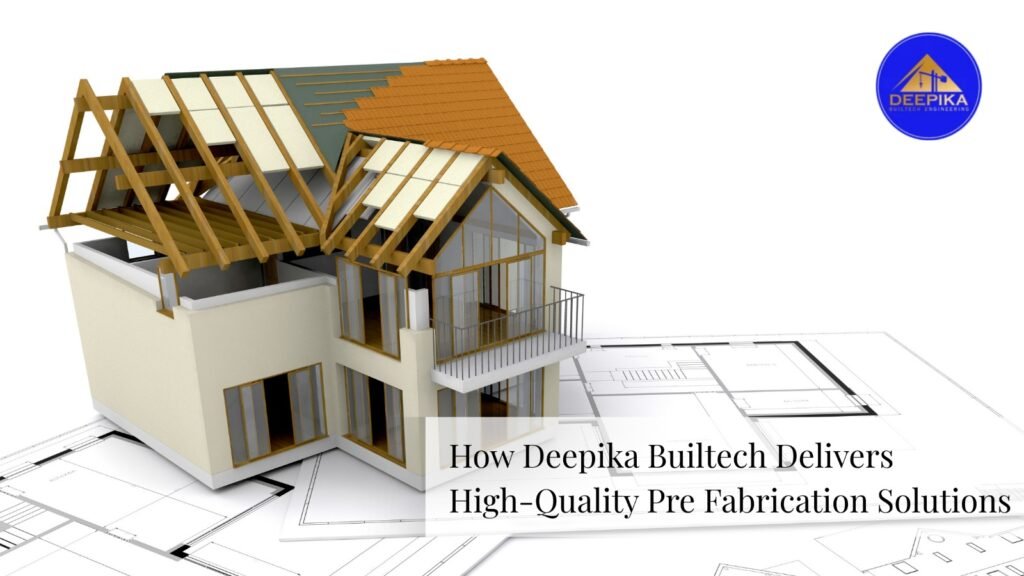
How Deepika Builtech Delivers High-Quality Pre Fabrication Solutions
Deepika Blogs

How Deepika Builtech Delivers High-Quality Pre Fabrication Solutions

How Deepika Builtech Delivers High-Quality Pre Fabrication Solutions Home Table of Contents In today’s rapidly changing construction environment, speed, accuracy, and cost-effectiveness are no longer a choice but a necessity. Businesses and developers are increasingly looking towards Pre Fabrication Solutions to achieve project deadlines on time while retaining the highest quality structural integrity. Deepika Builtech has established itself as a reliable player in this domain by providing trustworthy, long-lasting, and scalable prefabricated structures for various industries. This detailed resource article will delve into how Deepika Builtech maintains excellence in Pre Fabrication Solutions, the technology used, and why new-age construction companies are opting for their model. The Increasing Need for Pre Fabrication Solutions The conventional construction process has always been plagued by problems like project delays, material losses, weather-related setbacks, and quality inconsistencies. Pre Fabrication Solutions have overcome these problems by prefabricating building components in a factory setting before assemblage at the construction site. Why Pre Fabrication Is Gaining Momentum at a Rapid Pace Fast project completion Less dependence on manual labor Better quality control Predictable project costs Less material wastage Better structural longevity Deepika Builtech has led the charge in this revolution by leveraging its engineering prowess and fabrication technology.                              Deepika Builtech’s Quality-First Approach It is the quality-first approach that makes Deepika Builtech stand out in the industry. The company adheres to quality in every aspect of the Pre Fabrication Solutions process. Key Pillars of Their Quality Framework Precision engineering Use of premium-grade raw materials Latest manufacturing technology Well-trained technical staff Quality checks Client-centric customization By combining all these, Deepika Builtech is able to deliver projects that are of international construction quality. Advanced Design and Engineering Excellence Quality Pre Fabrication Solutions are the result of quality design. Deepika Builtech has invested heavily in the latest design and engineering tools to ensure that the structures are accurate and efficient. Design Capabilities 3D structural modeling Load analysis and simulation Custom architectural design Value engineering Error-free shop drawings With the latest CAD and BIM technology, the team at Deepika Builtech has been able to reduce design errors to a minimum and ensure smooth execution of the project on site. Benefit: Improved planning results in less rework and faster project delivery. Selection of Premium Materials The lifespan of any prefabricated structure is largely dependent on the quality of materials used. Deepika Builtech adheres to a rigorous selection process for all Pre Fabrication Solutions. Materials Used High-quality structural steel Galvanized parts Corrosion-resistant paints Insulated panels High-strength fasteners Quality checks are performed on every consignment of materials to ensure long-term functionality and safety. Result: Structures that can withstand adverse environmental conditions and heavy usage. State-of-the-Art Manufacturing Facilities Deepika Builtech’s state-of-the-art fabrication facilities are an essential part of providing consistent Pre Fabrication Solutions. Advantages of Manufacturing Automated cutting and welding CNC precision machines Factory-controlled environment Standardized production process Less human error Factory-made products guarantee consistent quality that is hard to attain through conventional site construction. Key Insight: Precision manufacturing increases accuracy by as much as 90%.                           Strict Quality Control and Testing Quality assurance is integrated into each step of the Pre Fabrication Solutions process at Deepika Builtech. Multi-Level Quality Checks Raw material testing Dimensional accuracy testing Weld quality testing Surface treatment testing Pre-dispatch testing On-site assembly monitoring Their own QA team ensures that each item meets project requirements before it is shipped. Faster Project Turnaround Time Turnaround time is one of the largest benefits of Pre Fabrication Solutions, and Deepika Builtech is a leader in fast project completion. How They Accomplish Fast Turnaround Times Simultaneous manufacturing and site work Pre-engineered parts Effective logistics planning Skilled installation crews On-site fabrication is kept to a minimum. Business Impact: Faster project completion translates to faster return on investment for their customers. Customization for Various Industries Deepika Builtech realizes that various industries have different infrastructure requirements. Their Pre Fabrication Solutions are highly customizable. Sectors Served Industrial warehouses Manufacturing units Commercial buildings Cold storage facilities Logistics hubs Agricultural structures Institutional buildings Their engineering team works in close coordination with clients to develop structures that perfectly fit operational needs.                                    Cost-Effective Construction Without Compromising Quality One of the most significant reasons why businesses opt for Pre Fabrication Solutions is cost-effectiveness. Deepika Builtech saves costs in multiple ways. How Costs Are Saved Material wastage is minimal Labor costs are low Project completion is faster Site overheads are low Budgeting is predictable Unlike traditional construction methods, prefabrication eliminates unexpected cost increments. ROI Advantage: Clients save more in the long run. Sustainable and Eco-Friendly Practices Sustainability is emerging as a high priority in today’s construction. Deepika Builtech is incorporating sustainable practices into its Pre Fabrication Solutions. Benefits of Green Construction Less construction waste Less carbon emissions Energy-efficient buildings Recyclable steel parts Less site disturbance Prefabrication is inherently supportive of sustainable development objectives while preserving structural integrity. Expert Project Management and Support Implementation is as crucial as design and production. Deepika Builtech offers comprehensive project management services for all Pre Fabrication Solutions. Client Support Includes Project planning and scheduling Technical advice Site management Installation monitoring Post-project assistance Their skilled project managers ensure seamless communication and timely completion. Safety and Compliance Standards Safety is not a compromise in the construction industry. Deepika Builtech adheres to the toughest safety standards in the industry for all Pre Fabrication Solutions.   Safety Standards Adherence to structural standards Safety guidelines for workers Safe installation methods Quality-tested materials Periodic safety checks This ensures minimum risks and maximum structural integrity in the long run. Why Businesses Choose Deepika Builtech Deepika Builtech has earned a reputation for providing reliable Pre Fabrication Solutions. The Most Important Reasons Why Clients Choose Them Established experience in the industry Engineering knowledge Up-to-date infrastructure Clear processes On-time project completion Competitive pricing Excellent after-sales service      

Why Choose Deepika Buildtech for Construction in Chennai?
Deepika Blogs

Why Choose Deepika Builtech for Construction in Chennai?

Why Choose Deepika Builtech for Construction in Chennai? Home Table of Contents The construction sector in Chennai is expanding at a very fast pace due to the development in the city and the increasing requirements for new generation infrastructure. No matter whether you are looking to establish a residential, commercial, warehouse, or industrial setup, it is the need of the hour to select the right partner for Construction in Chennai to get the best possible outcomes. Deepika Buildtech is one of the leading players in the sector, and it has gained a lot of popularity due to its engineering skills, professional project management, and customer-centric business model. In this detailed guide, we will discuss the reasons why people select Deepika Buildtech and how it provides the best construction services in Chennai. The Rising Need for Construction in Chennai Chennai has been ranked as one of the fastest-growing cities in the country of India. With IT parks, manufacturing units, logistics centers, and residential areas expanding across the city, the need for expert Construction in Chennai has been gradually increasing. The main factors that contribute to this rising need are: Urbanization Development of industrial corridors Increasing need for warehouses Development of commercial areas Rising demand for residential projects Infrastructure development In this highly competitive market, collaboration with an expert construction firm like Deepika Buildtech can be a major turning point in the success of projects. About Deepika Buildtech Deepika Buildtech has been acknowledged for its expertise in providing quality construction and engineering services to cater to the needs of various clients. The firm is dedicated to integrating its technical knowledge with the latest construction technology to provide long-lasting, cost-effective, and scalable structures.                                      Their service range would typically include: Pre-engineered buildings (PEB) Industrial construction Warehouse construction Commercial projects Civil construction projects Mezzanine floor solutions Turnkey project execution Their exemplary reputation for Construction Services in Chennai has been developed through their consistent performance and dedication to engineering excellence.                                                                 Top Reasons to Select Deepika Buildtech for Construction in Chennai Industry Experience Experience is one of the most important factors in construction. Deepika Buildtech has the experience of working on various construction projects. Why is it important? Better risk management Effective project planning Less chance of execution mistakes Strong vendor base Quick resolution of issues Deepika Buildtech has the experience to foresee issues and provide smooth construction results. Experience in Pre-Engineered Buildings (PEB) Deepika Buildtech has the expertise of pre-engineered steel buildings, which are in high demand for industrial and commercial Construction in Chennai. Advantages of PEB structures: Fast construction time Economical High strength Flexible design Easy expansion in the future Less maintenance For warehouses, factories, and industrial buildings, pre-engineered steel buildings provide a modern and flexible solution to construction.                                            End-to-End Turnkey Solutions Dealing with multiple vendors can result in project delays and cost escalation. Deepika Buildtech provides turnkey solutions for all their projects, right from planning to delivery. Their turnkey solutions encompass: Site selection Structural design Material sourcing Civil works Steel fabrication Installation and erection Quality checks Final delivery This end-to-end solution makes them the go-to choice for Construction in Chennai, particularly for businesses looking for hassle-free execution. Strong Focus on Quality Standards Quality is not a compromise in construction. Deepika Buildtech has a very strict quality control process in place for all their projects. Quality assurance involves: Use of high-quality raw materials Engineering standards Structural integrity checks Qualified manpower On-site monitoring Multiple quality checks Their focus on quality ensures that the structures they deliver are long-lasting and of industry standards. On-Time Project Completion Delays in projects are one of the primary worries in Construction in Chennai. Deepika Buildtech stresses the importance of effective project management for completing projects on time. How they stick to project timelines: Effective project planning Resource allocation Project managers Constant monitoring of progress Efficient processes Completing projects on time helps clients save on cost overruns and avoid delays. Cost-Effective Construction Solutions Controlling costs is essential in any construction project. Deepika Buildtech is committed to providing the best possible value without sacrificing quality. Cost-saving techniques: Effective material utilization Value engineering Innovative construction techniques Benefits of their vendor network Less rework Deepika Buildtech’s strategy ensures that expert Construction in Chennai services are more affordable for small and large businesses alike.                              Expert Engineering and Technical Staff Every successful construction project has a strong technical team backing it. Deepika Buildtech has expert engineers, designers, and site managers who work towards accuracy in every aspect. Strengths of the technical team: Structural knowledge Accuracy in design Adherence to safety standards Problem-solving skills Knowledge of modern construction techniques Their technical expertise is one of the major reasons for their popularity in the construction industry in Chennai. Customized Solutions for Every Project Not all construction projects are alike. Deepika Buildtech realizes this and provides customized solutions for every project according to the client’s needs. They customize solutions according to: Type of industry Budget limitations Site conditions Load capacity Future expansion plans Operational workflow This makes them a trustworthy partner for specialized Construction in Chennai projects. Effective Safety Procedures Safety in the construction industry is of utmost importance for both employees and the structural integrity of the building. Deepika Buildtech adheres to effective safety procedures at the construction site. Safety procedures include: Compliance with PPE Site safety audit Trained staff Safety checks of equipment Planning for risk mitigation Effective safety procedures minimize accidents and ensure smooth project execution. Client-Centric Approach Customer satisfaction is at the forefront of Deepika Buildtech’s business. They ensure open

Scroll to Top