

What Is the PEB Building Manufacturing Process? A Complete Step-by-Step Guide
Table of Contents
Introduction: What Most Buyers Never Find Out Until It Is Too Late
Most businesses that commission a PEB building in Chennai make the same mistake. They compare quotes, pick a price, and sign. They never ask a single question about how the building is actually made.
That matters more than most people realise. The PEB building manufacturing process is where quality is either built in or left out. By the time your structure is on site and going up, every engineering decision, the steel grade, the weld quality, the coating system, and the dimensional accuracy are already locked into every component on that truck.
If you have read about the latest construction trends in Chennai in 2026 or the steel buildings manufacturing trends covered on this site, you will have some context. This guide goes deeper. It walks you through every stage of the PEB building manufacturing process so you know exactly what a quality manufacturer does, where shortcuts are commonly taken, and what questions to ask before you commit.
What Is the PEB Building Manufacturing Process?
A Pre-Engineered Building is not built on your site from raw materials. It is engineered and fabricated in a factory, then transported to your site as a kit of precision-made structural components that bolt and weld together into a complete steel frame.
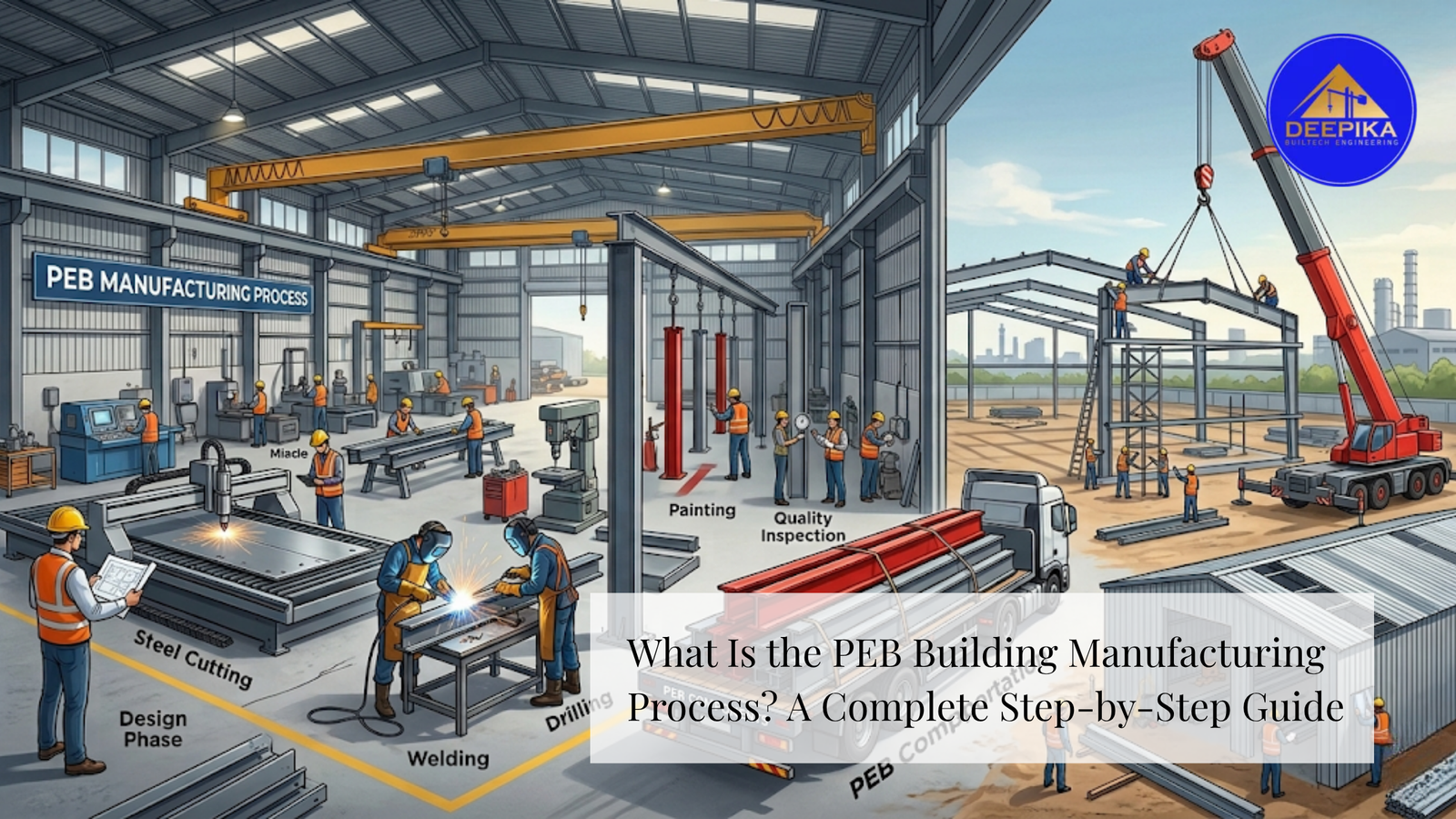
The PEB building manufacturing process covers everything from your initial load and span requirements through structural design, steel procurement, CNC fabrication, welding, protective coating, and quality-checked dispatch to your site. Site work foundations, erection, roofing, and cladding, then complete the build.
What separates a well-manufactured PEB building from a poorly made one is invisible once the structure is up. You cannot see the steel grade, the weld penetration depth, or the coating thickness from the outside. But you will see the consequences of poor manufacturing within a few years. That is why understanding the pre-engineered building construction steps before you choose a manufacturer is not optional. It is the most important due diligence step in your project.
Step-by-Step: The Complete PEB Building Manufacturing Process
Step 1: Client Brief and Load Requirement Analysis
The process starts with your requirements, not a standard template. Span width, bay spacing, roof pitch, wind load zone, floor load, crane capacity, if any, and intended use all feed into the initial design brief.
A serious manufacturer conducts a structured load requirement analysis before a single drawing is produced. Deepika Builtech does this through an on-site assessment at their Ambattur office, covering your exact site conditions, structural requirements, and operational needs before any engineering begins.
If a manufacturer skips this step and jumps straight to a standard design, that is a signal worth noting.
Step 2: Structural Design and Engineering Drawings
Once load requirements are confirmed, the structural engineering team produces primary frame designs, connection details, foundation load calculations, and fabrication drawings. These drawings define every member column, rafters, purlins, bracing, and crane beams with precise dimensions and material specifications aligned with BIS structural steel standards.
This is where the pre-engineered building construction steps are determined for the entire project. Any error at this stage propagates through every downstream step. The drawings must be reviewed and approved before fabrication begins.
Ask to see the structural drawings before you sign a contract. A manufacturer who cannot provide them has not done this step properly.
Step 3: Steel Procurement and Grade Verification
The structural drawings specify the steel grades required for each member. Primary frames typically use IS 2062 E250 or higher grade steel. Purlins and secondary members use cold-formed sections from the IS 811 specification material.
At Deepika Builtech’s manufacturing units in Kanchipuram and Thirumullaivoyal, incoming steel is verified against mill test certificates before it enters production. This step is frequently skipped by lower-cost manufacturers. The consequence is variable steel quality in the same structure, which creates unpredictable performance under load.
Step 4: CNC Cutting, Drilling and Plate Fabrication
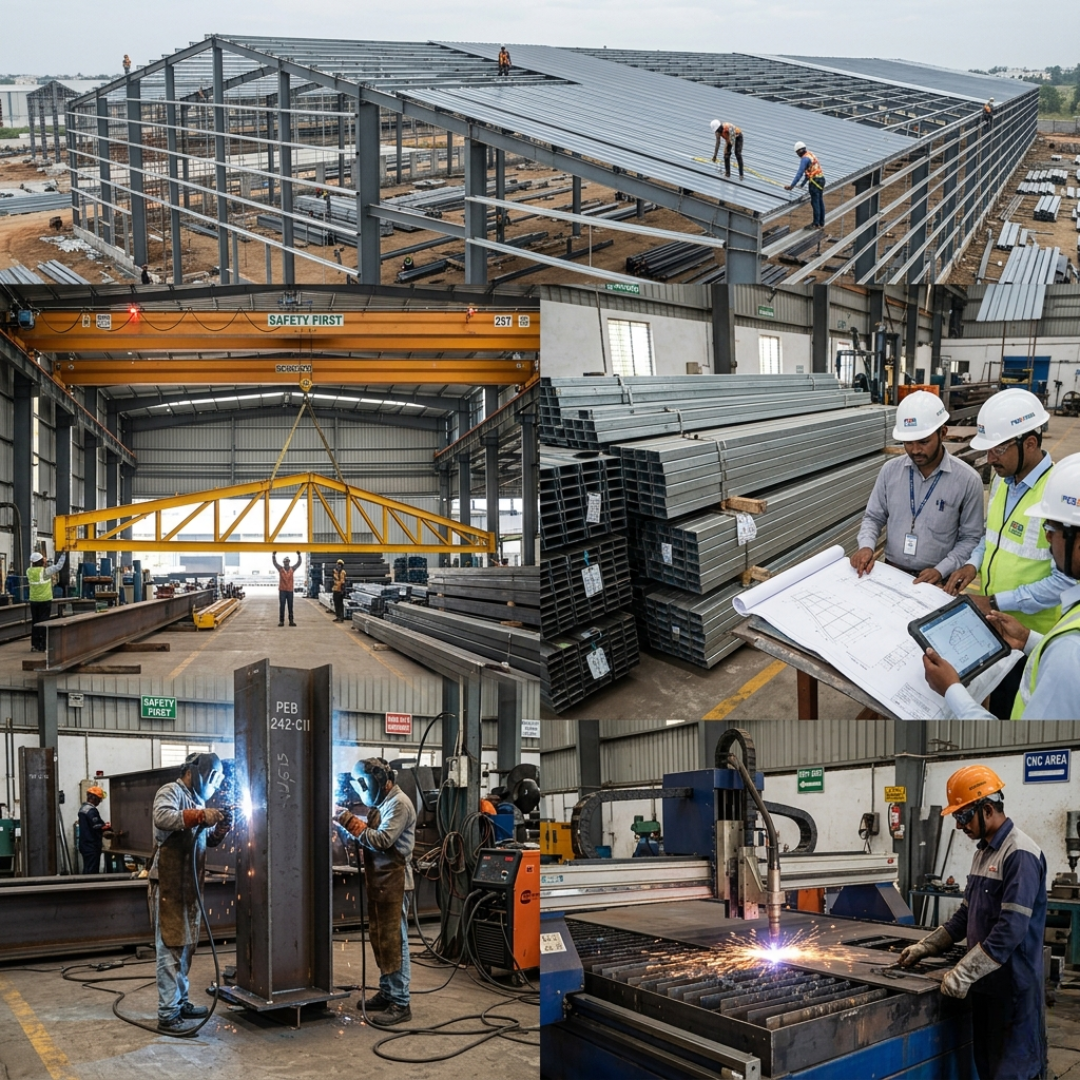
This is where the PEB steel structure fabrication process becomes measurably different between manufacturers. CNC plate cutting equipment produces components with a dimensional accuracy of plus or minus 0.5mm. Manual cutting produces tolerances of 3-5mm or worse.
Those tolerances matter on site. Misaligned bolt holes, columns that do not sit square on base plates, and rafters that do not meet correctly at the ridge are almost always traced back to inaccurate cutting at the fabrication stage.
Deepika Builtech uses CNC profiling and drilling machinery at both manufacturing units. Every cut plate and drilled hole is produced to drawing specification, not to a site operative’s judgment.
Step 5: Welding and Primary Frame Assembly
Primary structural members, columns and rafters are built-up sections welded from plates. The web and flange plates are fillet-welded using submerged arc welding (SAW) for consistent, full-penetration welds along the full member length.
Connection plates, stiffeners, and end plates are added using MAG and MIG welding processes. Every weld is a structural element. A weld that looks correct on the surface but lacks proper fusion depth will fail under cyclic load long before the design life is reached.
Ask your manufacturer which welding processes they use and whether welders are procedure-qualified. Deepika Builtech uses SAW for primary members, MIG for secondary connections, and CO2 for site joints, each matched to the joint type and load requirement.
Step 6: Shot Blasting and Protective Coating
Before any coating is applied, fabricated members go through shot blasting to the Sa 2.5 standard. This removes mill scale, rust, and surface contamination down to a clean steel surface. Without this step, any coating applied over contaminated steel will fail within two to three years, regardless of its specified thickness.
Chennai’s coastal humidity, monsoon moisture, and industrial atmosphere create aggressive corrosion conditions. TNPCB compliance for industrial facilities also specifies coating requirements for structural steel in certain zone classifications. Deepika Builtech applies a primer coat followed by a finish coat to a total dry film thickness appropriate for the project’s exposure category.
A structure built for a humid warehouse in Thirumullaivoyal needs a different coating specification from one built on a dry inland site. A manufacturer who applies the same coating to every project regardless of exposure conditions is not engineering the solution correctly.
Step 7: Secondary Members Fabrication
Secondary members, purlins, girts, eave struts, and base channels are roll-formed from coil steel into Z and C sections. These members carry the roof and wall sheeting loads back to the primary frame.
The dimensional accuracy of secondary members determines the straightness of your roof line and wall face. Variations in purlin depth or flange width create visible waves in the finished cladding and make sheeting installation more difficult.
Deepika Builtech produces secondary members at their own roll-forming lines, giving them direct control over section dimensions throughout production.
Step 8: Quality Inspection and Dispatch
Before any component leaves the factory, a final dimensional check is carried out against the fabrication drawings. Bolt holes are checked for pitch and diameter. Weld lengths and sizes are verified. Coating thickness is measured using a dry film thickness gauge.
Components are then tagged with a unique mark matching the erection drawing, which tells the site crew exactly where each piece goes during erection. Missing or incorrect markings are one of the most common causes of erection delays and on-site modifications.
Everything is then loaded for transport to your site, with components sequenced for erection order where the delivery schedule allows.
Step 9: Site Foundation and Civil Work
While factory fabrication is underway, civil work begins on site. Column base plates require correctly positioned anchor bolts cast into reinforced concrete foundations. The foundation design comes from the structural engineer and must match the column loads from the primary frame design.
Misaligned anchor bolts are one of the most expensive site problems in PEB erection. They typically require core-drilling, re-casting, or chemical anchoring all of which delay erection and add cost. Deepika Builtech’s construction services team manages foundation work in-house, meaning the same team that designed the primary frame is responsible for confirming foundation bolt positions before concrete is poured.
Step 10: Erection, Roofing and Final Handover
Erection begins with column installation and plumbing, followed by rafter assembly and bracing installation. Secondary members are then installed to complete the structural frame before roofing and wall cladding are fixed.
The erection sequence matters. Primary frames must be braced before releasing crane loads. Roof sheets must be installed in the correct lapping direction relative to the prevailing wind. Ridge caps, gutters, downpipes, and flashings complete the weathertight envelope.
The final handover package from a professional manufacturer includes as-built drawings, material certificates, coating inspection records, and a structural warranty. View Deepika Builtech’s completed PEB projects to see the standard of finish your facility should expect.
Complete PEB Manufacturing Process Reference Table
| Step | Stage | What Happens | Output |
|---|---|---|---|
| 1 | Client Brief | Load analysis, span requirements, site conditions, and intended use | Confirmed design brief and site data |
| 2 | Structural Design | Engineering drawings, member sizing, connection details, BIS compliance | Approved fabrication drawings |
| 3 | Steel Procurement | Grade verification, mill test certificate check, and incoming inspection | Certified steel in production |
| 4 | CNC Fabrication | CNC cutting, drilling, and plate profiling to drawing tolerance | Dimensionally accurate components |
| 5 | Welding | SAW primary frames, MIG/MAG connections, procedure-qualified welders | Structurally sound primary members |
| 6 | Shot Blasting and Coating | Sa 2.5 blast, primer and finish coat to the specified DFT | Corrosion-protected components |
| 7 | Secondary Members | Roll-formed purlins, girts, and eave struts to section specification | Dimensionally consistent secondary members |
| 8 | QC and Dispatch | Dimensional check, weld inspection, coating DFT measurement, and erection marking | Verified, tagged components ready for the site |
| 9 | Foundation and Civil | Anchor bolt setting, reinforced concrete foundations, pre-pour bolt check | Correctly positioned foundations |
| 10 | Erection and Handover | Frame erection, bracing, roofing, cladding, as-built docs, warranty | Completed facility with full documentation |
Why the Manufacturing Location Matters for Chennai Projects
Here is something most buyers overlook when comparing PEB quotes: where the building is manufactured affects both the quality of the product and the total cost of your project.
A manufacturer based in another state ships components to Chennai after a transit of 800 to 1,500 kilometres. Handling damage during long-distance transport is common, particularly for long-span members and finished sheet goods. Lead times are longer, site support during erection is more difficult to arrange, and any replacement components take days to arrive.
Deepika Builtech manufactures at two units in Tamil Nadu Kanchipuram and Thirumullaivoyal, with its head office in Ambattur, Chennai. Components travel shorter distances, handling damage is reduced, engineering support is accessible during erection, and replacement parts can be dispatched the same day if needed. For a Chennai industrial project, that is a supply chain advantage that affects both your construction timeline and your on-site experience.
What to Ask Your PEB Manufacturer Before You Sign
These questions will tell you more about the quality of a manufacturer’s PEB building manufacturing process than any brochure will:
- Which steel grades do you use for primary frames and secondary members?
- Do you verify incoming steel against mill test certificates?
- What CNC equipment do you use for cutting and drilling?
- Which welding processes are used for primary frame fabrication and are welders procedure-qualified?
- What is your shot blasting standard and coating specification for Chennai’s humidity conditions?
- How are components marked for erection sequencing?
- What does your quality inspection record include at dispatch?
- Can I visit your factory before committing to an order?
A manufacturer who answers all eight of these questions with specifics and evidence has a controlled production process. One who deflects, gives vague answers, or discourages a factory visit does not.
Why the Deepika Builtech PEB Building Manufacturing Process Stands Apart
Put Deepika Builtech against the ten steps in this guide, and the capability is consistent across every stage.
Structural design is done in-house by their own engineering team, aligned with BIS standards and Tamil Nadu’s specific wind and seismic load requirements. CNC cutting and drilling equipment at both Kanchipuram and Thirumullaivoyal manufacturing units produce components to drawing tolerance throughout every production run.
SAW primary frame welding, procedure-qualified welders, Sa 2.5 shot blasting, and a coating system specified for Chennai’s exposure conditions are standard across all projects, not premium options. Secondary members are roll-formed in-house on their own section lines.
Their quality inspection records, erection marking systems, and handover documentation packages reflect a manufacturing operation that has delivered 150+ completed projects across Chennai and Tamil Nadu. You can review their completed project portfolio and contact their team for a factory visit before you commit to any order.
Conclusion: Understanding the Process Changes the Outcome
The PEB building manufacturing process is where your facility’s structural performance, durability, and operational life are determined. By the time components arrive on your site, every engineering and manufacturing decision has already been made.
The businesses that commission PEB buildings that perform as expected for 20 to 30 years are the ones who understand the process, ask the right questions, and choose a manufacturer whose production capability matches their structural requirements.
Deepika Builtech’s PEB building manufacturing process, from load analysis through CNC fabrication, welding, protective coating, and quality-verified dispatch, is the reason their PEB structures in Chennai carry a track record of 150+ completed projects and 100+ satisfied clients. If your next project requires a manufacturer who can prove their process at every step, reach out here for a free consultation.
FAQs: PEB Building Manufacturing Process
1. What are the main steps in the PEB building manufacturing process?
The PEB building manufacturing process covers ten sequential stages: client brief and load analysis, structural engineering design, steel procurement and grade verification, CNC cutting and drilling, welding of primary frames, shot blasting and protective coating, secondary member fabrication, quality inspection and dispatch, site foundation and civil work, and finally, erection, roofing, and handover. Each stage depends on the accuracy of the previous one, which is why a controlled manufacturing operation produces measurably better outcomes than one where quality varies between production runs.
2. How does CNC fabrication improve the quality of PEB steel structure fabrication?
CNC cutting and drilling produce components with dimensional tolerances of plus or minus 0.5mm. Manual fabrication typically produces tolerances three to ten times wider. In PEB steel structure fabrication, those tolerances determine whether bolt holes align correctly, whether columns sit square on their base plates, and whether rafters meet accurately at connection points. Tight tolerances make erection faster and reduce the need for on-site modifications that delay completion and compromise structural integrity.
3. Why is protective coating critical in the PEB building manufacturing process for Chennai?
Chennai’s coastal humidity, monsoon rainfall, and industrial air quality create corrosion conditions that are significantly more aggressive than inland locations. A coating system applied over properly shot-blasted steel to the correct dry film thickness will protect the structure for its design life. A coating applied over contaminated steel or to insufficient thickness will begin to fail within two to three years, exposing primary structural members to accelerating corrosion. The shot blasting standard and coating specification should be matched to the project’s specific exposure category, not applied as a generic system across all sites.
4. Why should Chennai businesses choose Deepika Builtech for their PEB building manufacturing process?
Because Deepika Builtech controls every stage of the PEB building manufacturing process in-house across two Tamil Nadu manufacturing units. Structural design by their own engineers, CNC fabrication, SAW welding with procedure-qualified welders, Sa 2.5 shot blasting, coating systems specified for Chennai’s climate, in-house roll-formed secondary members, and documented quality inspection at dispatch. Their PEB construction service page outlines their technical capability, and their 150+ completed projects across Chennai and Tamil Nadu demonstrate consistent delivery at scale.
5. How do I get started with Deepika Builtech for a PEB building project in Chennai?
Call +91 96000 67611 or email dbtechengg@gmail.com to arrange a free initial consultation. You can also submit your enquiry via the contact page. The first step is a load requirement discussion and site assessment, after which their engineering team produces a detailed scope, structural design brief, and project delivery plan. A factory visit to either their Kanchipuram or Thirumullaivoyal manufacturing unit can be arranged before any commitment. View their completed PEB projects to see what the finished product looks like.
