


Table of Contents
Why Is Quality Building Material Important for Construction?
Introduction
Take a walk through any neighbourhood in the city, from the heritage streets of Mylapore to the skyscrapers that are sprouting up along GST Road, and what you are seeing is the direct outcome of quality building material selections that were made many years before the structures were ever built.
From the bricks that are used, the rods, and the bags of cement, it all plays a part in determining whether a building will be a landmark for many decades to come or a maintenance headache for its owners. In the rapidly developing city of Chennai, where the building industry contributes more than 12% to the city’s GDP, the importance of building material selections has never been greater.
This original guide will show readers exactly why quality building materials are at the heart of every successful building project, and how experienced building contractors in Chennai can apply that knowledge to the structures they build.
Defining Quality Building Material
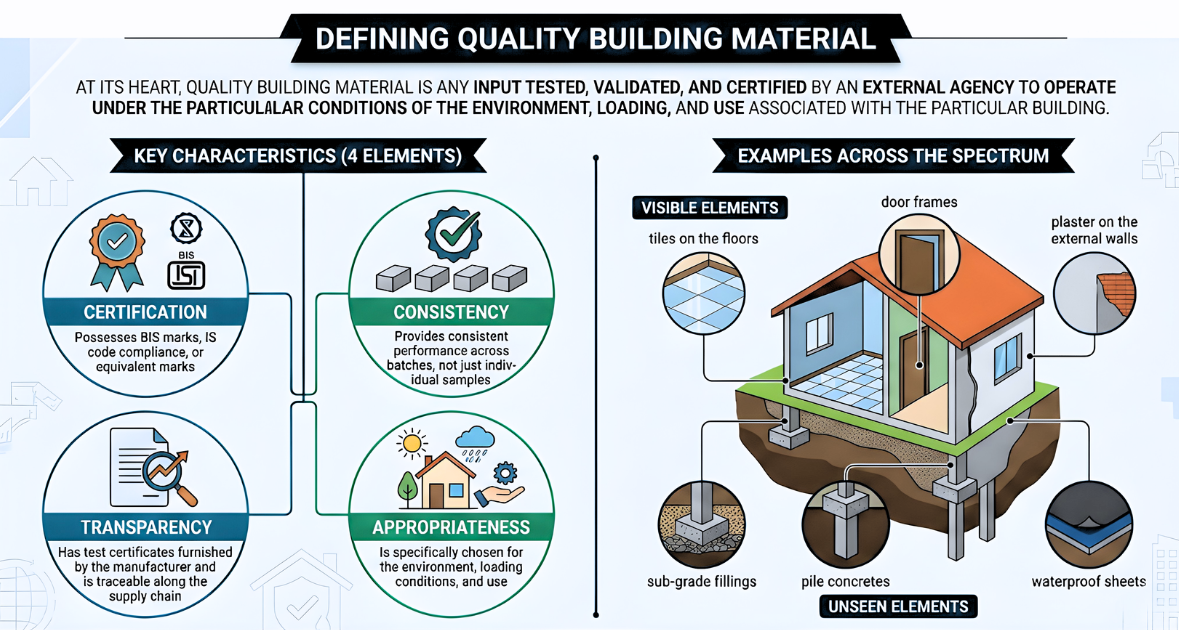
At its heart, quality building material is any input into the building process which has already been tested, validated, and certified by an external agency to operate under the particular conditions of the environment, loading, and use associated with the particular building.
This can range across the spectrum from the unseen elements buried underground (sub-grade fillings, pile concretes, waterproof sheets) to the very visible elements which the residents use every day (tiles on the floors, door frames, plaster on the external walls). Across the entire spectrum, quality building materials are characterised by four key elements:
- Certification: Possesses BIS marks, IS code compliance, or equivalent marks
- Consistency: Provides consistent performance across batches, not just individual samples
- Transparency: Has test certificates furnished by the manufacturer and is traceable along the supply chain
- Appropriateness: Is specifically chosen for the environment, loading conditions, and use
Why Quality Building Material Is Non-Negotiable
Structural Safety & Load Bearing Capacity
No factor is more closely tied to a building’s safety history than the quality of the building materials used to construct its structural frame. Columns, beams, slabs, and foundations all rely entirely on the consistent quality of cement, steel, and aggregate materials and how a weakness in one of them can set off a chain of failures.
The Indian National Building Code (NBC 2016) specifies a minimum grade of building materials because empirical data from the field confirms that poor-quality materials are the primary cause of distress in low-rise structures. Even in Chennai’s seismically active Zone III classification, a structure built with low-grade steel or concrete would not be able to withstand the horizontal forces of even a moderate earthquake event.
Long-Term Durability & Cost Efficiency
The selection of quality building materials is an investment decision with significant returns. A building constructed with premium quality building materials would generally have a design life of 60-80 years with normal maintenance, while another building constructed with economically designed substandard materials would start showing spalling, cracking, and settlement within the first decade of its life.
A lifecycle cost analysis of 50 residential projects in Tamil Nadu showed that structures built with premium quality building materials ended up saving an average of 38% less on structural repair costs over a period of 25 years compared to structures where the budget for building materials was slashed by 10-12% during procurement. This saving was completely offset within six years.
Climate Resilience & Energy Performance
The unique climatic fingerprint of Chennai, characterised by high levels of coastal humidity, summer temperatures consistently rising above 40 degrees Celsius, and the ever-present danger of cyclone-borne rains, makes it necessary to use quality building materials that are specifically designed to cope with these specific stressors.
For example, the effects of saline humidity on steel corrosion, the effects of thermal cycling on masonry joints, and the effects of monsoon rains on roofs are all mitigated by the use of quality building materials of the appropriate kind, including CRS-grade TMT bars, thermally broken window profiles, APP membrane waterproofing, and cement products containing additives of GGBS (Ground Granulated Blast Furnace Slag) for sulfate resistance, respectively.
In addition to their resilience, quality building materials with high thermal insulation properties, such as AAC blocks, low-E glass, and solar reflectance coatings, can reduce a building’s cooling energy consumption by 20 to 35 percentage, a significant figure considering the entire lifespan of a building.
Visual Excellence & Market Value
The correlation between the use of quality building material and the financial performance of the property is well established. Real estate builders along the premium residential routes of Boat Club Road, Nungambakkam, and Sholinganallur have consistently realised 10-18% higher per square foot prices by explicitly communicating the use of quality building material to the customers.
Premium large-format vitrified tiles, architectural aluminium windows, moisture-cure PU paints, and engineered wood flooring are not just design decisions. They are quality building material investments that can lead to reduced maintenance costs, enhanced tenant satisfaction, and improved resale potential.
Real-Life Construction Scenarios from Chennai
Scenario A: The Invisible Waterproofing Failure, Sholinganallur (2022)
The developer purchased an uncertified, market-grade waterproofing material for the terrace and basement of the 96-apartment complex in Sholinganallur. The developer replaced the specified APP membrane with the new material, saving approximately ₹5.2 lakhs on the overall project costs. Within 22 months of occupation, active seepage was reported in 31 apartments. The emergency works, which included breaking the existing finishes, application of the certified quality building material systems, and re-finishing the areas, incurred costs of ₹41 lakhs. The developer also suffered the consequences of the consumer court complaint against them, which reflected on the sale of their next project in the micro-market.
Scenario B: Steel Grade Mismatch Caught Pre-Pour, Perungudi (2023)
In a routine third-party quality audit of a commercial complex at Perungudi, the engineer conducting the audit found that the TMT bars received were marked as Fe 415 instead of the specified Fe 500D grade of steel. The reason for this was a shortcut taken during procurement to meet a tight deadline for delivery of the materials. The entire consignment of 28 metric tonnes was replaced with certified quality building material before any concrete was laid. The project was held up by 10 days, but a major flaw was avoided that would have compromised the structure by 22%.
Scenario C: A Quality-First Success Story, ECR Villa Project (2021–2024)
One of the renowned building construction companies in Chennai undertook a 44-villa community development project on the East Coast Road, with an assurance of meeting each and every quality building material specification without fail and issuing a material test certificate with every material supplied.
Marine CRS steel, Ramco Supercrete cement, ISI-marked HDPE pipes, and IGBC-approved AAC blocks were the main building materials. Four years post-handover, the development has witnessed zero complaints, with an average increase of 26% in resale values compared to the area benchmark.
How Building Contractors Chennai Select & Verify Materials
What really differentiates good building contractors in Chennai from the average ones is never really the skills possessed, but the degree of attention paid to the quality procurement and verification of building materials.
A quality management process for building materials, as adopted by the best building contractors in Chennai, would normally be a five-step process:
- Stage 1: Specification Lock-In: Minimum quality specifications for building materials (like M30 grade for concrete, Fe 500D grade for steel) are fixed before the actual procurement process begins.
- Stage 2: Vendor Qualification: Only vendors who possess valid BIS licenses, ISO 9001, and a minimum 3-year experience on similar types of projects are selected.
- Stage 3: Pre-Delivery Testing: Random samples are dispatched for independent testing at labs affiliated with Anna University or NABL-accredited private organisations.
- Stage 4: Site Receipt Inspection: A quality engineer checks the markings, batch numbers, and quantities before unloading the goods.
- Stage 5: In-Process Testing: Tests for concrete cube, rebar bend, tile water absorption, etc., are conducted at regular intervals
The most progressive building contractors Chennai has to offer are now employing Material Management Software (MMS) combined with QR-code tagging, which enables their clients to scan a column or slab of building material and immediately retrieve the batch data, test certificates, and delivery records embedded within that particular structure of building material.
Essential Quality Building Materials by Category
Cement
OPC 53 Grade and Portland Pozzolana Cement (PPC) supplied by UltraTech, Ramco, and Dalmia Cement are the quality building materials required for structural concretes in Chennai.
Reinforcement Steel
Fe 500D CRS TMT Steel Bars are the quality building materials required for all reinforcement works in the coastal environment of Chennai.
Masonry Units
Fly Ash Bricks conforming to IS 12894 and Autoclaved Aerated Concrete Blocks are the quality building materials required for masonry works in Chennai, as compared to conventional burnt bricks, because of their low dead loads, better insulation, and lower carbon footprints, apart from reduced water consumption in masonry works.
Fine Aggregates
Manufactured Sand (M-Sand) conforming to IS 383 has emerged as the quality building material required for concrete and masonry works in Chennai, replacing River Sand.
Waterproofing Systems
APP and SBS Modified Bitumen Torch-On Membranes, Crystalline Waterproofing Compounds, and Polyurethane Liquid Membranes are the quality building materials required for waterproofing works in the high-rainfall and high-humidity environment of Chennai, for terraces, basements, bathrooms, and podium decks of buildings in Chennai.
Practical Checklist for Identifying Quality Building Material
This handy checklist can be employed before accepting any delivery:
- Cement: Presence of ISI marking on each bag; check the manufacture date (within 90 days)
- Steel: Presence of embossed marks on the grade along the length of the bars; request MTC reports for yield strength and elongation
- Bricks/Blocks: Request test reports for water absorption and compressive strength; check if the absorption is within 20%
- M-Sand: Confirm silt content test results are within 5%; check if the zone classification matches the mix design
- Tiles: Confirm PEI rating for application
- Waterproofing: Confirm thickness tolerance and pull-off adhesion test results
- Pipes & Fittings: Confirm the presence of ISI/ASTM marks; check wall thickness gauge
Conclusion
For every single rupee invested in quality building materials, there are compounding returns to expect from structural integrity, cost savings, energy efficiency, and overall asset value.
Collaborating with quality building contractors in Chennai who understand quality building materials procurement as an absolute non-negotiable professional requirement rather than a budgetary constraint is perhaps the most impactful decision that a project owner can take.
In a city as ever-changing, climatically challenged, and populated as Chennai, the structures we develop today must serve the citizens of tomorrow. That begins and ends with our quality building materials commitments before ever digging the first foundation pit.
Frequently Asked Questions (FAQs)
1. What is quality building material, and why is it important?
Quality building material is any construction input, including cement, steel, bricks, and finishes, that has been independently certified, tested, and proven to meet established standards of performance. It is important because it has a direct bearing on the safety, longevity, and maintenance of a building. A building is only as strong and durable as the weakest component of building material.
2. What quality building material is most important to a home foundation in Chennai?
For a home foundation in Chennai, the three most important quality building materials are OPC 53 grade cement, which provides high early strength; Fe 500D CRS TMT bars, which provide seismic ductility and resistance to corrosion; and IS 383 M-sand, which provides a consistent gradation of concrete mix. These three quality building materials combine to produce a foundation system strong enough to withstand the seismic Zone III requirements of Chennai, as well as the high sub-soil moisture of the area.
3. How do building contractors in Chennai verify the quality of the building materials on site?
Building contractors in Chennai with experience follow a multi-layered verification process. First off, building contractors in Chennai examine the Material Test Certificates of the manufacturer before delivery. Once the building materials are delivered, a quality control engineer examines the physical markings, batch numbers, and quantities of the building materials received. During construction, building contractors in Chennai test the cube strength of concrete at 7 days and 28 days, rebar bend tests, and tile water absorption tests to ensure quality building material is performing as expected through all stages of construction.
4. Is quality building material substantially more expensive than other building materials?
Quality building material is only 8-15% more expensive than other building materials at the time of purchase. However, lifecycle costing studies prove that this additional investment is recovered within 5-8 years of owning the property through reduced maintenance costs, emergency work, improved energy efficiency, and increased resale value. Properties that try to save 10% on building material costs end up spending 3-5 times that amount on remediation within the first decade of construction.
5. What are the consequences of using low-grade materials in construction?
If sub-standard quality building materials are used instead of certified quality building materials, the consequences would be cracking and spalling, seepage and penetration of dampness, corrosion of reinforcement, increased bills for consumption of energy and, in some cases, the building might collapse completely. In addition, the developers would be liable for court cases, would lose credibility with RERA, and would also lose face, which would impact the sale of the building.
